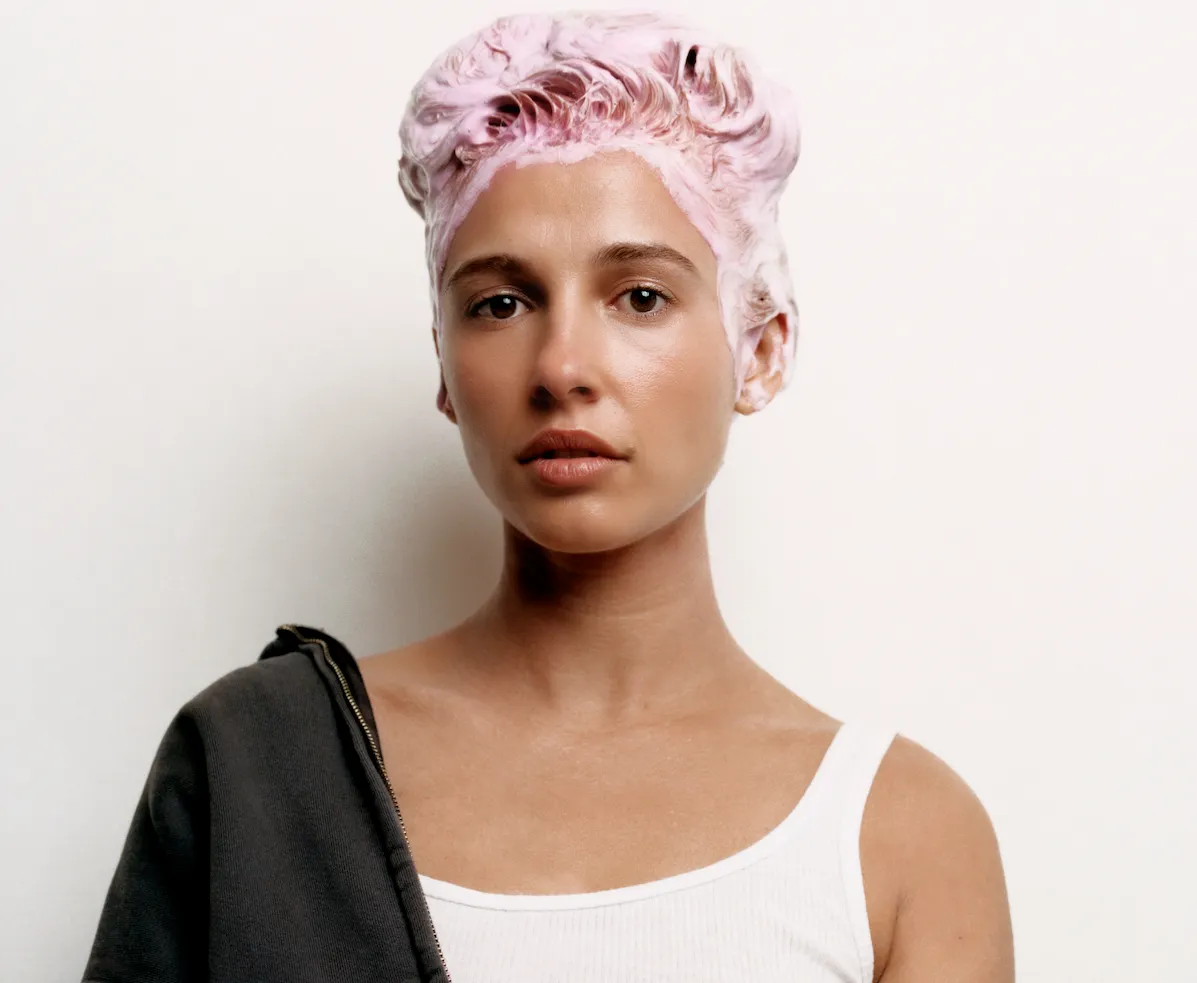
Halfway through our February afternoon conversation, Naomi Scott poses a question that, frankly, many people would prefer to avoid: “What is she, where does she belong?”
She’s speaking about herself, but from the vantage point of aggregated audiences and studio executives who want to categorize a half-Indian, half-white actress who excels in American roles. The industry confronted a puzzle: how do you slot a stunning, gifted actress-singer who just co-starred in a Disney blockbuster worth billions into the right kind of part?
After her breakout as Jasmine in Disney’s 2019 live-action Aladdin, Scott didn’t appear in another film for nearly five years. The usual entry on her Wikipedia page cites a hiatus, but she offers a more practical rationale: “The roles weren’t there.” The right opportunities, at least. As she notes, without industry connections to shepherd you, finding feasible parts can be tough. A global pandemic didn’t help matters. Nor did being of mixed race. “As a person of color, you don’t necessarily get the lucky breaks,” she says. When she finally returned to cinema with an acclaimed turn in Smile 2, she did so as a pop star. If the commercial trajectory holds, a year from now she’ll be living that reality in person as well.
Ahead of its release next Friday, Scott’s debut album, F.I.G, sits in the alt-pop spectrum—intimate and stylish at once—an artful collage that nods to the world of Phil Collins, Robyn, Kate Bush, and other legends from pop’s yesteryears. On tracks like “Cherry,” she blends a hushed soprano with a flirtatious playfulness, a song that feels like Janet Jackson picking up a British cadence. Guided by electric guitar riffs that glide and moody percussion, “Sweet Nausea” lets Scott dwell in a delicious unease: “Baby, hope you don’t mind if I stay here/ Spin me around until I’m queasy/ Just the way I want it.” Her voice is smooth and sensuous, like pillow talk with someone you don’t have to pretend to admire. The sparse, buttery bed of sound crafted by Lido envelops her vocal tone, holding it like a comforting cover. Flexible and powerfully controlled, F.I.G is Scott’s most deliberate project yet. And that is because she orchestrated every choice.
“With music, you have more freedom to steer and define the process yourself, to set the structure and shape what making it looks like,” she explains the distinction between recording music and filming movies. “You aren’t constrained by someone else’s schedule, vision, deadlines, or creative directions.” In short, she doesn’t have to worry about someone else’s notion of where she belongs.
And this time, she had a say in who else would be involved. The first collaborator she invited was Lido, a producer who has worked with everyone from Halsey to Ariana Grande. It began with a June 2023 direct message Scott sent after hearing his work with Jordan Ward. A FaceTime session followed, and they discovered they lived just about five minutes apart in Los Angeles. What started as an informal partnership matured into a formal one when Scott brought a curry dish to his home and asked him to executive-produce her album.
“Some sessions aren’t really about making music,” Lido notes. “That particular one was more about conversation and aligning on what we wanted to accomplish together.” Part of aligning involved leafing through an enormous PDF Scott had compiled, full of musical references and concepts to guide her project.
“I remember looking at it and thinking, ‘Oh, you’ve seen this kind of presentation before, and now you’re crafting your own,’” recalls Lido. “That instantly told me she cared about building a world around the music—she wasn’t just after tracks that sounded good. She aimed to create a holistic thing.”
That summer, Scott began tracking in a pool-house‑like studio in LA belonging to Lido. When not recording there, she’d head to Lido’s studio space in Norway, a repurposed former elementary school he had acquired. There would be cooking, abundant tea, and long conversations. Even as Scott steered the album’s course, her collaboration with Lido remained deeply collaborative.
The writing portion felt natural as well. Lido noticed, while flipping through Scott’s Dropbox of electric-piano demos that would become the album’s backbone, that they were “incredibly well-crafted songs.” “The moment I heard them, I felt, ‘These are superbly written tunes. The tough part is over. We already know what this is.’” he says. “This is clearly someone who’s well-read and capable of conveying stories. Someone who knows how to express themselves, which makes your job as a producer—one who should encourage and draw out those qualities—much easier.”
That degree of lyrical nuance didn’t always appear in her earlier material. Her initial pair of EPs, Invisible Division (2014) and Promises (2016), read more like fragments than cohesive visions. There are awkward ballads (“Running”) and at least one generic American Apparel‑styled pop anthem (“Motions”). The vocal talent was evident, but in her youth—and not fully in control of her sound—it all felt a bit scattered. “I was trying things,” she reflects on those earlier records. “I knew that when I released music next, it had to be incredibly intentional.”
That intention both anchors and lifts F.I.G, which Scott says she re-recorded three times so she could deliver each track perfectly. While her earlier releases presented a young woman experimenting with styles, F.I.G is a self-tailored look designed for the catwalk. And even with its achievement, Scott doesn’t view the album as her ceiling—even if conventional, formulaic career paths might whisper otherwise.
“The notion of what it means to be a woman in pop was so narrow and ageist: you do X by twenty, you’re done,” she says. Yet watching other vocalists thrive well into their 30s and 40s gave her a broader view. “We see remarkable artists in their mid-to-late 30s and 40s—Robyn, Caroline Polachek, Christine and the Queens—whose work remains compelling,” Scott observes. “When I decided not to accept the idea that it’s too late, I realized I could carve out my own space and shape it. I might as well go and do it myself.”
So far, taking matters into her own hands has yielded a strong album. Hopefully, it will also translate into more frequent touring. Recently, Scott opened for her close friend Dev Hynes when Blood Orange played in London. Lido admires Scott’s live performances: “She sits in a shrinking category of artists who sound the same on stage as they do on record.” He believes this quality could propel Scott’s music to be as big as, if not bigger than, her acting career.
Even though she’s riding off a Smile 2 performance that likely deserved an Oscar nod, it feels as though Scott has a more intimate bond with her own music. And why wouldn’t she? She’s in command. It’s hers. If you ask her, it’s her. “When you act in a movie, you’re one of the collaborators, but you aren’t the visionary for it. You’re a tool being utilized,” she explains. “Music is far more personal. It’s yours.”
F.I.G drops 3/20 via ALTER Music.