

“We’re gonna attempt to crack the pit at the Olivia Rodrigo show,” Kate Halter grins. A month prior, that would have sounded like an insane thing to say. For one thing, Rodrigo’s concerts don’t feature pits. Rodrigo headlines arenas, and those arenas are filled with seats — seats that are currently commanding four-figure sums on the secondary market. No one moshes at Olivia Rodrigo gigs. And another wrinkle: nobody would have guessed that Rodrigo would align with Halter’s raucous Austin noise-punk crew Die Spitz as tourmates — not until it actually happened, anyway.
On a Sunday afternoon in May, Halter and her three bandmates are gathered in their curtained-off backstage green room at Salt Lake City’s Kilby Block Party, just an hour or two after they delivered a sweaty and anarchic set on the festival’s smallest stage. A couple of weekends earlier, Kilby announced Die Spitz as openers for many of the European dates on Rodrigo’s Unraveled Tour. In the months ahead they’ll also perform at Rodrigo’s Daisy Chain Fields festival. And they’ll push to open the pit. They’re not sure how it’ll unfold.
The Die Spitz women are all in their early twenties, roughly the same age as Rodrigo. Like the pop star, they’re driven by the ghosts and energy of earlier generations of rockers. Like Rodrigo, they became serious about music during the pandemic. But that’s where the similarities end. Die Spitz’s sound leans on beer-stained riffing and raw, guttural singing. It’s a celebratory throwback to the era of Babes In Toyland and 7 Year Bitch. The band cut its teeth in Austin dive bars. Their first proper tour was with OFF!, the once-vaunted supergroup of ’80s hardcore legends. It’s a pairing that, to put it mildly, is unlikely.
Halter, looking ahead, says, “The shows are going to be massive. You can’t really see people’s faces, which makes us less nervous.”
Her bandmate Ava Schrobilgen interjects: “I mean, I am nervous. I suspect some of [Rodrigo’s fans] won’t vibe with us.” Someone else chimes in that that’s fine, and Schrobilgen quickly agrees, “She’s clearly pop, but she’s got an edge too! She’s really cool!”
The Die Spitz members all sound like they’re processing this new career turn in real time. None of them had ever attended an Olivia Rodrigo show before. They haven’t met Rodrigo yet, though they did speak with her once. (Halter: “She said her dad’s a big fan.”) They recognize these concerts as a big deal that will introduce Die Spitz to entirely new audiences. Drummer Chloe de St. Aubin says, “We currently attract a predominantly male, older crowd. We’re genuinely excited to play for people who’re more in our demographic.”
Schrobilgen concurs: “We’ve never toured with anyone our own age before.”
The legends check out. Die Spitz formed as a way to justify hanging out more often. Three of the four members hadn’t even played in a band before coming together as Die Spitz. They were just friends in Austin. Schrobilgen and singer/guitarist Eleanor Livingston have known each other since preschool, and they met Halter in middle school. Chloe de St. Aubin is the odd one out, since she didn’t truly know them until quite recently and wasn’t a full member when they did their first show.
Back then Ava Schrobilgen played drums (and still sometimes does), but she wanted to front the band, so Die Spitz needed another drummer. It was January 2022, and the other three hadn’t yet figured out how to be in a band. Their first gig was at the Hole In The Wall, a storied Austin venue that could seat a few hundred people. Now they all laugh at how badly they played that night.
“We didn’t understand how a show actually functions, so we brought three separate cars,” Halter recalls, “We brought a PA system. We brought monitors. We brought our own mics and stands.”
“We assumed they’d provide all that,” Livingston adds.
Schrobilgen cackles, “We were so full of ourselves!”
“I think it’s just the mindset of a 19-year-old who drinks a lot and thinks, ‘I’ll do whatever I want!’
“I only played a handful of songs during the set with them,” de St. Aubin remembers. “They’d bring me onstage mid-set, and I’d be somewhere in the crowd.”
“We told her to open the pit, to provoke moshing,” Halter jokes.
De St. Aubin did her best. “I tried to spark something, but at the time I was pretty shy, so it felt really stressful to be the one saying, ‘Jump in, guys! But I’m scared too!’
At the time, the others didn’t think de St. Aubin was really eager to join the band. “We had this really awkward standoff where we were going to ask her, and we were all nervous,” Halter says.
The “standoff,” as Halter calls it, happened in Die Spitz’s rehearsal space shortly after de St. Aubin watched the others play a song. She can’t recall which tune it was, but it left an impression. “I was sitting in a beanbag very close to them, right under Ellie’s bass,” she says. “I thought, ‘This is what I want to be doing. I’m really, really into this.’ I fell in love. We were all out on the deck, and it felt like asking out your crush, like two people who like each other but won’t admit it. We all sat in silence, smoking, and I thought, ‘I want to be in this band, for real.’”
Backstage in Salt Lake City, all four members of Die Spitz are quieter than you’d expect, but they come alive when recounting that moment. They grin at one another, giggle at each other’s additions to the story, and talk over one another. It’s clear to see: they adore being in this band.
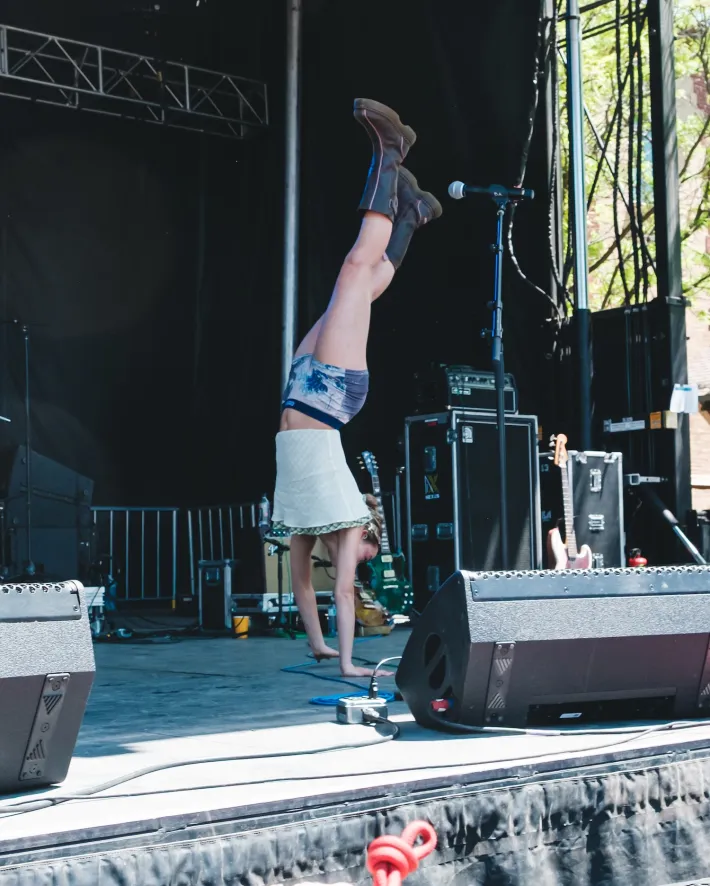
When Die Spitz take the Kilby stage, the love for the project is visible before they even strike a chord. Kate Halter performs a handstand-walk across the full length of the stage before she crouches to pick up her bass as Kesha’s “Blow” blares from the PA. After a few tracks, Ava Schrobilgen jumps behind the kit, while Chloe de St. Aubin selects a guitar and sings—the first of many instrument swaps. Eleanor Livingston wields a mic stand like a baton, her flaming red hair whipping around as she pumps a fist. The pit expands. The Die Spitz quartet never stops grinning. They’re arguably having more joy than anyone in the crowd, and the crowd is reveling in it too.
As the set ends, Die Spitz sprint to the other side of the festival grounds to catch Show Me The Body tearing it up with ferocity. Later, when I mention that Die Spitz might be the heaviest act on the bill, Schrobilgen corrects me, insisting the heavier force is actually SMTB. I grasp what she means, though SMTB edges into the weirdly heavy realm. Die Spitz carry a weight in the classic sense—a Sabbath-esque churn of riffs, gargled roars, and lyrics about flinging yourself toward symbolic or literal swords. They’re a proudly horned, old-school metal monster in a scene that often leans toward indie, which makes them a true anomaly at Kilby and a certain inevitability when they join Olivia Rodrigo’s tour.
There are subcultures where this grit and grime thrive, but Die Spitz aren’t exactly creatures of doom metal or stoner-psych underground scenes. Instead, they’re a product of Austin’s historically unbounded music ecosystem—a place where hardcore bands like Iron Age carved their own heroic-metal path, where Levitation thrives, and where you can still spot Frank Kozik posters from the ’90s plastered on venue walls. In their debut year as a band, Die Spitz earned high-profile slots at SXSW and Levitation. In their second year, they released their ultra-grimy EP Teeth and hit the road, first with OFF!, then with Amyl And The Sniffers. Things escalated quickly.
Early 2025 saw Die Spitz sign with Jack White’s Third Man Records after label scouts caught one of their SXSW sets. They’re quick to point out that it was an unofficial SXSW appearance: “F— South By!” Livingston says, “I still think about it: If I hadn’t played those shows, where would I be now? I was so sick with the flu.”
Months after inking the deal, Die Spitz released Something To Consume, a ferocious and propulsive full-length debut, produced by Turnstile/Title Fight’s Will Yip. In conjunction with the album, the band rolled out a series of bold, cinematic videos shot around Austin. In the “Throw Yourself To The Sword” clip, they brandish literal swords while wandering through a laundromat and a grocery store. “I used to visit that laundromat every week,” Halter says. “Now, I’ve found a better one.”
Die Spitz have moved with astonishing speed, hitting major career milestones in rapid succession, and the whole experience still feels novel. When I ask how many festivals they’d played prior to Kilby, they’re not sure—fewer than ten, probably. Yet they’re festival junkies. At Kilby they sprint from set to set, trying to catch as many as possible. To keep time for this interview, they have to skip Snail Mail, which isn’t ideal.
To hear them tell it, Die Spitz can’t stand being apart even when they aren’t on the road. Schrobilgen says, “We’ll be at home, and we’ll spend maybe a week, probably less, hanging out with our partners or other friends, just chilling. Then I start to feel, like, ill and so sad, and when I see them again I’m like, ‘Oh my god, I’m okay! We’re all okay!'”
“We’re also chatting in a group chat the whole time,” Halter adds. “We go shopping together all the time.”
“We decided we’ve got enough friends already,” says Schrobilgen. “We don’t need any more. We’re not going to go out of our way to make more. I’ve got all I need.”