
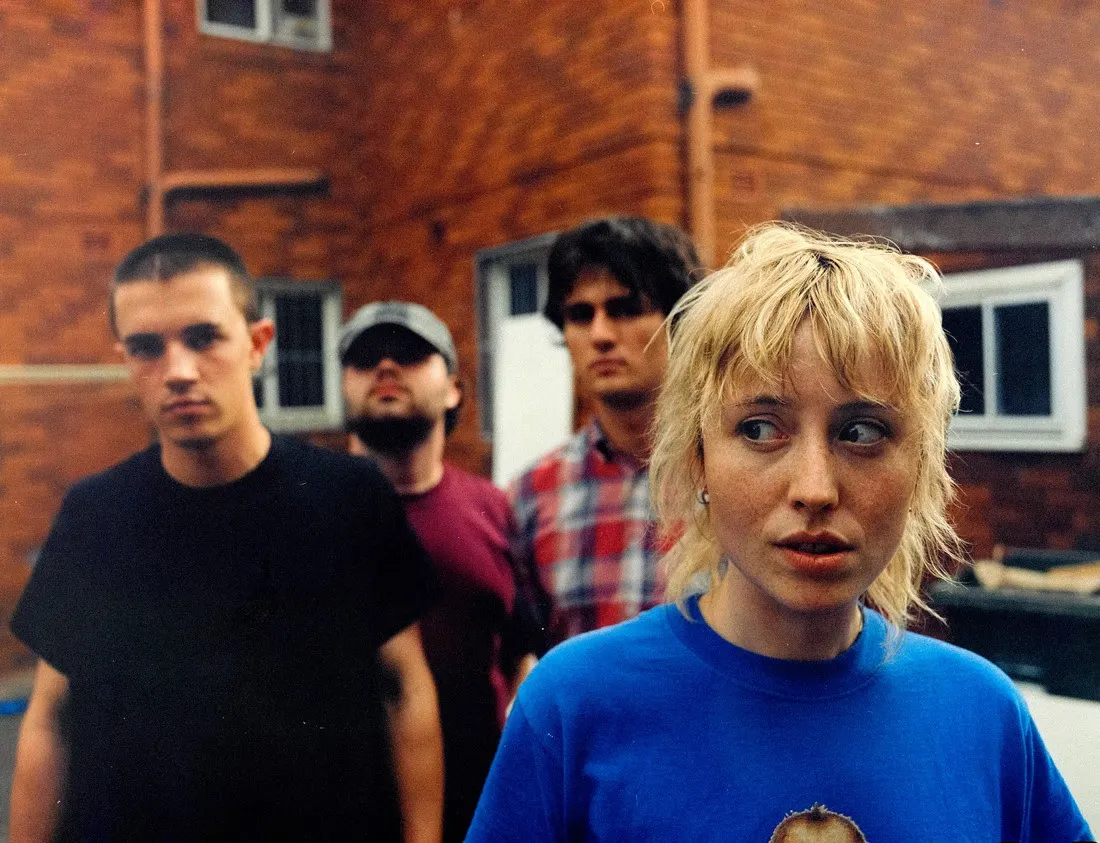
At the heart of Swapmeet’s music are the songs themselves. A lot of contemporary indie outfits filter the echo of 1990s alt-rock through the Bandcamp-era sensibility associated with Alex G, yet the Adelaide quartet excites with melodies that set them apart. The four members, all 24 years old, split writing duties and frequently switch instruments, traversing from hushed, delicate beauty to eruptive grit without ever losing the core voice they’ve shaped since their teen years cohorted together. After signing with the reliably excellent Los Angeles label Winspear, they’ve spent six months steadily releasing their debut album Mount Zero, with each new single further proving their command of the craft.
“I Know!” was the first to surface and left a strong, lasting mark. It’s a seemingly simple anthem built on two chords and a piercing, looping hook that becomes the scaffolding for a compact symphony of moving parts, textures weaving in and out of the arrangement with the precision of a machine waking up. Next came “Sand,” a looser, fuzzier ascent that slides from a bright, airy drift into a heavy, emotional fall as Venus O’Broin and Jack Medlyn trade vocal lines. “2 C U” arrives short and sweet, growing from spare acoustic beginnings into another intricate tapestry of evolving layers. And perhaps no moment on the record is as overwhelming as the late flourish in “Halfway,” when the track explodes into a triumphant torrent of guitars.
On the day, Swapmeet offer one final preview ahead of Mount Zero’s release this Friday. The track “Bonny” pairs contagious forward motion with a tinge of sadness from the outset. The mood shifts multiple times, a handful of clever chord changes reshaping the atmosphere, yet the momentum remains unbroken. It’s one of many cuts on Mount Zero — a title drawn from a landmark about halfway along the nine-hour drive between Adelaide and Melbourne — where the perennial, modern anxieties of youth intertwine with timeless concerns, crafted with care yet bursting with life.
I was glad to hop on a video call with Venus O’Broin and Maxwell Elchick last week to discuss Swapmeet’s beginnings and how they arrived at such a tremendous debut. Below, hear “Bonny” and read our conversation.
As a big dumb American, I don’t know much about the cultural distinctions between Australian cities and regions. Could you tell me a bit about Adelaide in relation to the rest of the country, culturally or musically? Is there something distinctive about your city and its history that should be known?
VENUS O’BROIN: It’s the one city that wasn’t built by convicts when they arrived. It was settled a little later by other communities. I think we have fewer city-to-city differences than you see in America, but we’re a bit of an outlier.
MAXWELL ELPHICK: Geographically, we sit on the southern edge of Australia, so you’ve got us and then, basically, Antarctica below. That also means Adelaide isn’t exactly a throughway for travelers; people don’t pass through here en route somewhere else. It isn’t a tourist hotspot. It’s a city that sits a little apart from the rest of the country.
Do you think there’s anything particularly Adelaide-like about Swapmeet? Is there something about your band that you consciously draw from being from there?
ELPHICK: I’d say our live show is the most Adelaide thing about us.
OK, how so?
ELPHICK: It starts with how we perform at gigs. During lockdown, and with Adelaide audiences tending not to dance a lot, we developed a habit of channeling a lot of energy on stage — going full tilt, loud as we can. When we’ve taken that approach to other cities, it sometimes looks like we’re overdoing it.
O’BROIN: The scene here has always been pretty unpretentious. Or it used to be.
Do you think it’s getting more pretentious?
O’BROIN: Absolutely, and it’s our fault.
You mean your group is responsible for that shift?
O’BROIN: Well, our circle grew up around making music that diverged from what had come before, a group of people who liked to talk about music. I’m not sure the scene before us was the same. It felt like there was a lean toward just raw rock and booze, and we started taking things a bit more seriously — which, in our view, is a good thing.
You’ve said the live show is high-energy. Listening to the EP and the album back-to-back, it seems you’ve pushed the energy higher in the studio than on the EP. Was that deliberate?
ELPHICK: I think that’s mostly us getting better at recording and understanding what we want the songs to sound like. Early on, bridging the gap between live performance and studio capture was tricky; now we have a clearer sense of how those tracks should feel on record.
There’s a kind of ongoing experimentation—learning the studio versus pushing the songs to another level—and then there’s another kind of experimentation where you feel you’ve become masters of the studio, and you explore differently.
O’BROIN: Absolutely—masters of the studio, for sure.
Maxwell, one of the press notes quotes Mount Zero as “a place you pass but never go.” It became a symbol for people you’d see but never meet. When you were writing and recording, why did that image resonate?
ELPHICK: It captured a moment in time when we were on the move a lot, trying new things and meeting people without ever fully exploring them. It’s easier to write about those experiences when you’re living them rather than later reflecting on them.
So it’s a shorthand for the habit of constant motion—go, go, go—and the difficulty of pausing to reflect.
ELPHICK: Exactly. It also speaks to early-20s energy: you don’t yet know exactly what you’re doing, and you’re trying to figure it all out. It feels like the opposite of childhood’s open-ended time, and as you become an adult things seem to accelerate, leaving less room to reflect.
I read that the album centers on “first loves, first heartbreaks, first embarrassments, first disasters.” OK, what disasters do you mean?
O’BROIN: Disasters here run from heartbreak to the drama of life on tour, the moments that feel catastrophic in the moment but aren’t in retrospect. It’s the kind of disaster you survive and carry forward.
So the disasters are tied to heartbreak, then?
O’BROIN: Probably, unless Maxwell has a weekend-to-weekend catastrophe to share.
You tracked the album at a beach house. How did that place come into the plan?
ELCHICK: It was a rescue from other methods that weren’t working. We’d tried recording at our own place, but coordinating everyone in the same room for long stretches was tough. The beach house gave us a single location where we could all stay, all night, and record for as long as needed. No noise complaints either—and it was great.
You all slept in the same room, too?
ELPHICK: Yes, in a studio setup that included bunk beds and the equipment in the same big room. The place was enormous, with the studio and the beds sharing space.
Was that a deliberate “all-in” choice, or did it just happen to be where the beds were?
ELPHICK: It happened to be the setup. There was something about the bunk beds absorbing sound and a view of the ocean that felt right.
How did you secure access to it? Was it a rental?
ELPHICK: It belonged to Jack’s partner’s parents, so we were incredibly lucky.
People have mentioned Jack’s preference for using Ableton to edit and sculpt the songs. How do the writing and recording processes interact? Do you wait until a song is tracked to decide if it’s finished, or can you rework it indefinitely? You don’t come across as a “computer band,” but I’m curious how it informs the workflow.
O’BROIN: In the past, we’d write and perform live, then realize the studio version didn’t capture what we’d heard in our heads. We’d revise and relearn the song in a new form. For this record, we entered with a clearer sense of what we needed from the tracks, and we stayed open to reworking them. Before finishing a song, we’d let it go through recording, experimentation, and editing, then relearn how to play it in its final version. It was a natural next step toward finishing the song.
What about the value of those edits—how do they improve the song?
O’BROIN: You can hear it. Seeing the option to add more can be hard to resist, and we’re not shy about refining something until it feels as good as it can be. We’re not perfectionists, but the impulse to improve is strong—perhaps due to ADHD, perhaps just a habit. It meant dealing with a mountain of tracks; Hamish Mitchell, who mixed the record, spent the first couple of days trimming down the sessions. It doesn’t feel finished until we’ve pushed it past the edge of finish.
“I Know!” makes for a striking opening track and lead single because it really jolts you awake. How did that one come together?
ELPHICK: It arose from a jam. We were supposed to play a show that very night and soundcheck was imminent, but we started playing around and the song formed almost immediately. The version out now remains pretty close to a voice memo we captured, which is rare for us—we usually sit on songs for a long time and only later refine them. It tends to be more collaborative in the moment than a drawn-out, premeditated process.
O’BROIN: We all sensed that simple, immediate spark was the magic. Releasing it before the rest of the album gave it a fresh impact.
ELPHICK: It was one of the newer tunes we wrote for the album, so it didn’t feel like something already sitting in the back catalog. That kept it feeling new and alive.
It’s interesting how the chorus sticks with that single “I know” line, looping the riff and lyric without much variation. Did you ever consider altering it?
ELPHICK: To be honest, changing it would have felt a bit cringey—like we were nudging it to go somewhere it didn’t belong. It works as-is, and that simplicity is part of its appeal.
O’BROIN: I wondered if it might be too much at first—how the song opens with a long “do do.” But we settled on, “Okay, you’re drawn in; that’s not our problem.”
“Sand” also stood out for me. It seems to tackle the act of wasting time scrolling through a phone, a very contemporary yet fairly mundane subject. How do you make a song from that feel thrilling?
O’BROIN: Jack wrote that one, so I’ll defer to him on specifics. But I admire how Jack takes ordinary moments and turns them into art. I, by contrast, tend to need everything to break before I can express a thought in a line.
ELPHICK: A lot of the energy in that track rides on its musicality. It may not be obvious, but it probably contains more tracks than any other song we cut — perhaps 120 or so. There are countless tiny elements that appear for just a moment, often a single note, and those micro-details push the whole thing forward.
Venus, you’ve said you have to work hard to coax even a sliver of writing out. Do you enjoy writing, or is it painful?
O’BROIN: Not a matter of enjoyment so much as necessity. When something’s happening, you need to translate it into words, especially the immediacy of heartbreak, which is easier to put into language and hard to keep inside. I’m still learning to write lyrics the way Jack does, drawing from the world around me. The album’s recording timeline happened to align with some of that heartbreak.
Did some heartbreak coincide with the recording?
O’BROIN: Yes, quite a bit.
I suppose if you’re going to go through it, might as well do so while making your debut.
O’BROIN: Exactly. So I’m grateful for it.
Earlier you mentioned building a web of friends around the scene, and you described Adelaide as a place that isn’t a destination. How does a band like yours break out from there? Is it mostly online connections, or do you log a lot of miles? What’s the route from Adelaide to the wider world?
ELPHICK: It helps to have friends in other cities. We were lucky to have a connection with a band called Garage Sale, who snatched us up when we only had one song out. Our friend Benji Luke pushed us to perform more, and those early shows with them helped us meet more people. We were fortunate to jump into a scene from such a distance in the best possible way, which made it feel less like climbing a ladder and more like skipping ahead to play with bands we admired.
O’BROIN: We’re still figuring it out, and there isn’t a map for escaping Adelaide. And yes, we’re still here, still figuring it out.
Was relocation ever on the table for you?
O’BROIN: I lived in Melbourne last year, and I moved back to save money when I learned we’d be heading to America. It’s something I think about every morning, even as the band loves what we’re doing. We’d be eager to be somewhere else if the right chance came along.
You joked about taking a vow of celibacy while recording. Is that actually true?
ELPHICK: That’s a joke. We should probably drop it now.
O’BROIN: It’s a joke too. We did plenty of things, trust me. The joke stands here, though—we weren’t celibate. OK? All good.
Good to hear.
So you’ve done a lot of press about this album this year. What have you learned about Mount Zero from all these conversations?
ELPHICK: I’ve noticed how people interpret individual songs differently from what we intended. I like that. I don’t want anyone to hear a track and know exactly what we’re saying. It’s fascinating when listeners discover their own meanings. It’s helped me understand the songs in new ways beyond my initial thinking.
Was there a particular track where your view shifted?
ELPHICK: I can’t recall specifics, but there was a moment when someone asked whether a sonic shift in a song tied to a lyric I’d discussed earlier; I’m not sure it did, but it felt possible in a way that made me question the writing itself. It reminded me of that idea Jeff Tweedy talks about—lyrics sometimes feel random until months later you realize they weren’t at all. It’s about finding those connections.
That reminds me of Wilco’s Misunderstood moment, with the repeated “nothing” bit—have you drawn anything from Wilco in this process?
O’BROIN: You’re the first to mention Wilco, but my morning routine during the two weeks we were recording involved blasting Yankee Hotel Foxtrot while I got ready. It’s a big touchstone for us.
O’BROIN: We even riffed on Ashes Of American Flags. It’s not a direct lift, but the guitar figure in “My Heart Breaks II” came from memory of that vibe.
That kind of rippling influence—filtered through your own voice—becomes something new, which is the best kind of homage.
ELPHICK: It was as if we tried to replicate the riff by memory and ended up with something different entirely.
Is there anything else you’d like to add that I haven’t asked about?
O’BROIN: A quick nod to our friend Jackson Phillips, who played a crucial role in this record. He’s a brilliant creative mind and one of our closest friends; the album wouldn’t feel the same without him.nThe Day Wave guy?
O’BROIN: No—this is Jackson Phillips from Jack—different person. Our long-time friend Jackson helped us a lot, and he was around the house during recording. When we were stuck, he’d say, “Just do this.”
O’BROIN: He even did a remix of “I Know!” that’s up on SoundCloud; it’s really good.
So he was there to encourage, jam, and contribute?
ELPHICK: He helped bring balance to the lineup and often tipped the scales toward a decision after a jam. His involvement kept the process collaborative and alive.
Mount Zero is out 7/17 on Winspear.