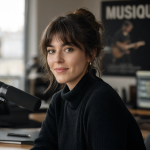
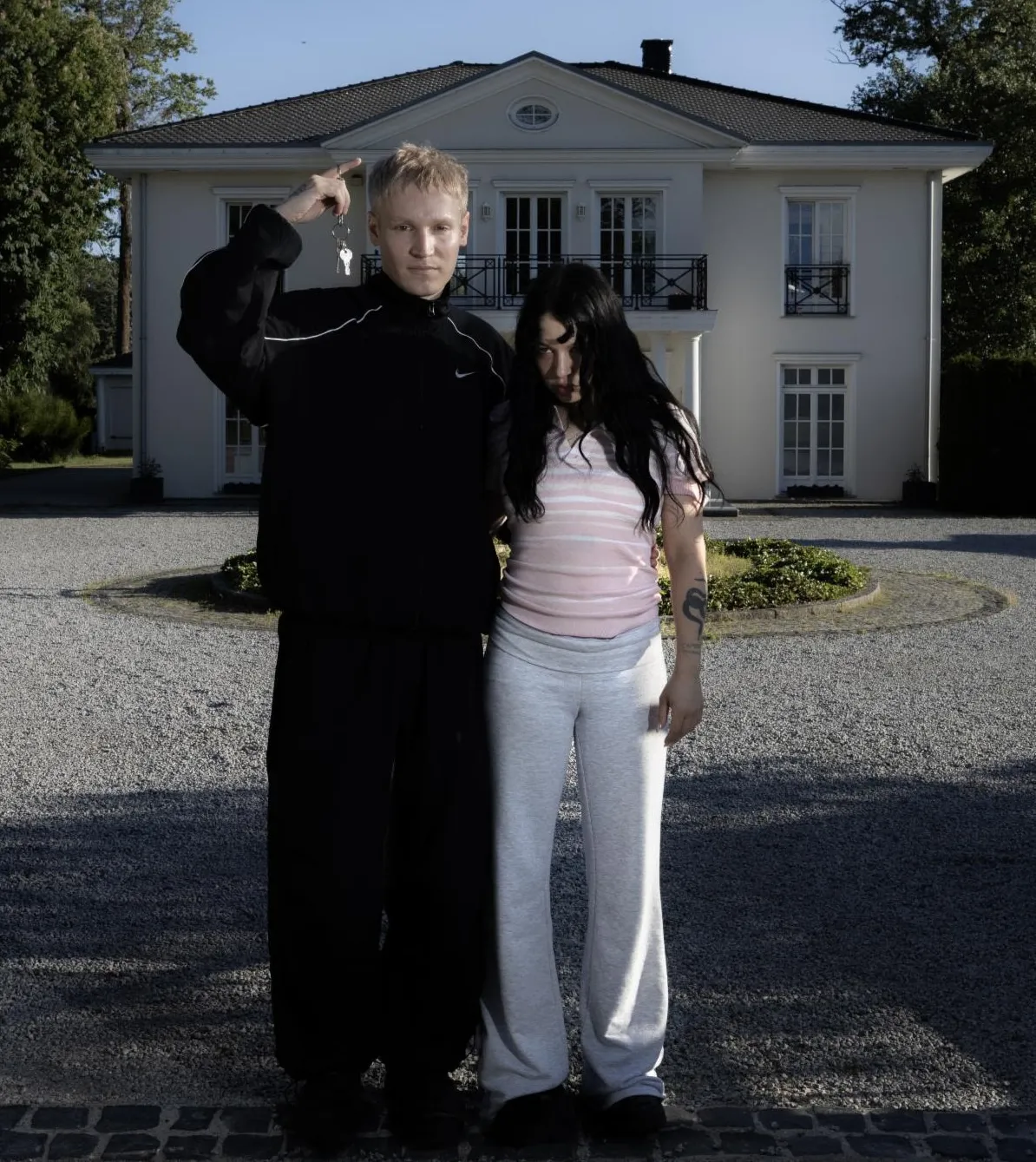
Brutalismus 3000, the collaboration between producer Theo Zeitner and vocalist Victoria Vassiliki Daldas, appears within a Zoom frame from their Berlin home, set against a Blade artwork—a creature that’s part human, part vampire—standing before an American flag. The scene feels tailor-made for an act whose art thrives on friction, distortion, and cultural clashes. It’s audacious, vivid, and absolutely exhilarating.
The duo’s second full-length, Harmony, released today, is a relentless collection of tracks that keep morphing and pushing toward a breaking point. Initiated by Zeitner with co-production from Boys Noize and Dylan Brady of 100 gecs, and featuring guests from British-Argentine actress Anya Taylor-Joy to electronic legends Underworld, the record stands as a carefully balanced, collaborative “album” in scope—more so than their 2023 debut Ultrakunst. Across its 13 cuts, Brutalismus 3000 forge a world where hardcore, gabber, and industrial pressure fuse and then dissolves into something oddly cinematic. It’s music that provokes a full-body response, a near-overload of sensation that makes the mind and body crave escape.
“I think we need to be in a healthy place, in a calm moment. We have to be in balance,” Daldas explains, anchoring the album’s chaos in an unexpected philosophy of emotional regulation, and even a shot of tequila. That sense of equilibrium forms the hidden architecture beneath the roar: a gripping tension between brutality and lucidity, between music that feels possessed and music that suddenly blooms with pop clarity. Even when things are most structured, Harmony resists solidity, leaning into volatility as a creative engine.
In its most extreme moments, the album tilts into a hallucinatory realm. Beats land like mischievous demon balls, while layers of fuzz and industrial static swell into mushroom-cloud atmospheres of distortion and abstract poetry. The imagery includes a menacing taxi driver, toothless grins, and a profusion of firearms. Screams are halted mid-breath only to reemerge later as specters within the mix. Within this haze, details fracture and reassemble: children’s voices echo like static from a playground, screams vanish then return, and whole tracks feel as if they’re mutating from a techno eruption into doom-laden collapse in motion.
Beyond the abrasive surface, there’s a surprising emotional pull. Moments of quiet, memory, and return surface at times. “You Were Never Really Here But I Miss Ya” lands as a playful hauntological pop moment, while the collaboration with Underworld, “Friends At The Pigshed,” offers a grander, more transcendent shimmer. Zeitner notes that the initial aim for Harmony was to deliver “good music but really bad vibes.” Yet lightness and harmony began to seep into the process toward its end. After more than a year of globe-spanning work—from Los Angeles and New York to Portugal and beyond—the project was brought home during the final four months, finished in their own manner. “That was the most important part of the process,” he smiles.
That return to home base becomes Harmony’s grounding axis: a record born from sensory overload and chaos, ultimately stitched together through intimacy. In our conversation, Zeitner and Daldas spoke about the core influences shaping the album. Portions of that discussion follow below.
Poetry As Gateway To Songwriting
THEO ZEITNER: Our influences are so varied from what we actually make, yet they still linger as the main sparks. Think Leonard Cohen—his lyrics, in particular, feel incredibly inspiring even though the music itself isn’t similar at all.
VICTORIA VASSILIKI DALDAS: We have shelves lined with poetry books by Cohen and Nick Cave.
Did you approach these collaborations with set rules, or did you mostly allow the sessions to unfold in the room and see what happened?
ZEITNER: With Underworld, it’s unique because someone else wrote for the project. Karl Hyde composes in a completely different way from us. He has years of material, scribbled lyrics from countless notebooks. “I wrote this in Berlin. Let’s do this. You’re from Berlin—let’s craft this track.” We then tweaked it in the studio, and Vicky contributed new lines, while we built the track together in the room. As for the other collaborations, they didn’t follow that pattern; the lyrics became distinctly ours.
VASSILIKI DALDAS: We commenced with poetry that we both collected, then pulled out the strongest lines and stitched them together. We rarely draft a song in a traditional structure. It’s more like poetry at first, from which we extract the best fragments and shape them to fit the music.
So poetry and songwriting merge for you?
VASSILIKI DALDAS: Yes, they interlock.
ZEITNER: Some sections are easier to conceive as poems—scribble everything out, let it become a rough, sometimes striking piece, then distill it into a song structure. Writing within a strict verse-chorus framework feels like a different discipline—almost like drafting a screenplay or a novel. It’s more enjoyable to approach writing as if you’re composing prose.
So you don’t see yourselves as traditional songwriters?
ZEITNER: In a sense, we’re not your textbook songwriters.
VASSILIKI DALDAS: For me, crafting a narrative on paper doesn’t click. My approach tends to be more abstract, expressing emotions and experiences rather than pinpoint topics. It’s more poetic and less about concrete storyline.
Death Grips & D.A.F.
VASSILIKI DALDAS: We’re enormous fans of Death Grips, and I found their lyric approach—almost stream-of-consciousness, but fiercely aggressive and abstruse—highly influential. It also resonated with how German punk bands like D.A.F. convey a lot with minimal means.
Good Music With Really Bad Vibes
ZEITNER: It wasn’t about completely abandoning the harsh sound—gabber and hardcore remained, but we shed the need to fit into a club’s ritual. For the first time, we crafted the album for the album itself, not to suit a late-night set. I hope it will still feel right when played in a club later.
What mindset accompanied the creation of Harmony? How did the project begin to crystallize?
ZEITNER: We started with the title Harmony and a rough plan to forge a fiercely aggressive, toxic record that would worsen the world in some way. It was a deliberate move against toxic positivity—opting for a record that’s “good music but really bad vibes.” From there, the tracks launched as aggressively tense, but as the process evolved, it became lighter and more joyful in ways we hadn’t anticipated. The second year of work diverged significantly from the first.
VASSILIKI DALDAS: We initially threw every idea on the table, which was chaotic. Eventually a through-line emerged—a red thread, or a harmony, if you like—that helped shape the record into something that could be experienced as a whole. The actual recording process carried a generally harmonious feel, even when addressing darker themes or political topics. We also collaborated with people we genuinely wanted to work with.
Horror Films Audition (1999) & Kairo (2001) & Safe (1995)
ZEITNER: Horror, for me, represents something appealingly overwhelming—an ADHD-friendly pull that can feel strangely soothing. The intensity of emotion on screen can be oddly calming, and that is also a thread within our music: a fierce energy that remains fascinating at every turn. The same drive is at work here—the music aims to be intensely aggressive in a way that resonates emotionally.
VASSILIKI DALDAS: For me, it’s the punching combination of aggression with a sense of mystery, a thread that runs through German punk as well. Growing up, mosh pits and raw energy shaped how I hear intensity. The calming effect comes from the contrast—the fear and the thrill can feel strangely comforting to the brain.
That’s very true, and I relate—my family isn’t into horror, yet I’m drawn to it. There’s something about stepping into that discomfort that feels less daunting than avoiding it.
ZEITNER: Exactly. When a film makes you feel something—fear and laughter in equal measure—it achieves a rare, almost magical balance. Horror and comedy often share this goal: if a film can truly frighten you and genuinely make you chuckle, that’s a remarkable achievement.
Perhaps I’m reading into it, but the Japanese titles you cited, like Audition and Pulse, carry deeply unsettling atmospheres that remain haunting with delicate, piano-driven textures at times.
VASSILIKI DALDAS: European cinema often captures a sense of deep dread, loneliness, and isolation with a stark, inhuman distance. It’s a different lens for showing a world that feels less populated, less human.
ZEITNER: That sensibility fits our music in moments—a surface that seems sunny or light, with a dark undertone beneath. The video for “I Bring My Gun To The Function” leans into a cute, almost inviting vibe that quietly carries a military undertone. It’s a balance we explore. On the previous album, we wrote “Gevalt Gevalt,” which translates roughly to “violence, violence”—for some listeners, it sounded like anxiety in a club; for us, it captured the sense of a war invading your space while you dance. That’s the feeling we’re often portraying—a gentle exterior layered over a creeping dread.
VASSILIKI DALDAS: Overall, cinema is a major wellspring for us. We try to absorb a film’s mood and translate it into song, sometimes revisiting Lynch’s works for aesthetic cues. Safe (1995) and Kairo, as mentioned, clearly influenced our approach to loneliness and the idea of humanity thinning away. It’s the apocalypse of sadness, in a way.
ZEITNER: The feeling of melancholy threaded through joy—this mix often appears in our work.
VASSILIKI DALDAS: We also draw from playful, anarchic sources like John Waters, finding his chaotic style a fruitful engine for turning cinema into song.
Nostalgia
ZEITNER: Nostalgia pulls me strongly; I’m drawn to old video tapes and vintage horror, for reasons I can’t quite name.
VASSILIKI DALDAS: We even played PlayStation 2 yesterday, and bought an old Jackass game [laughs]. If you could peek at our flat, you’d see how much nostalgia shapes us.
ZEITNER: It can be bittersweet, yet strange beauty surfaces in it. The Underworld track feels especially nostalgic—it conjures a sense of comfort and melancholy in Karl Hyde’s vocals, a memory of our early 20s when moving here felt like partying was our only job, a different time altogether [laughs].
It oscillates between a somber and a sunny mood, which is intriguing and captures something honest about escapism—and perhaps a trap.
VASSILIKI DALDAS: Nostalgia sometimes feels fake, like remembering something that wasn’t quite as you recall.
Harmony is out now on Live From Earth/Columbia.