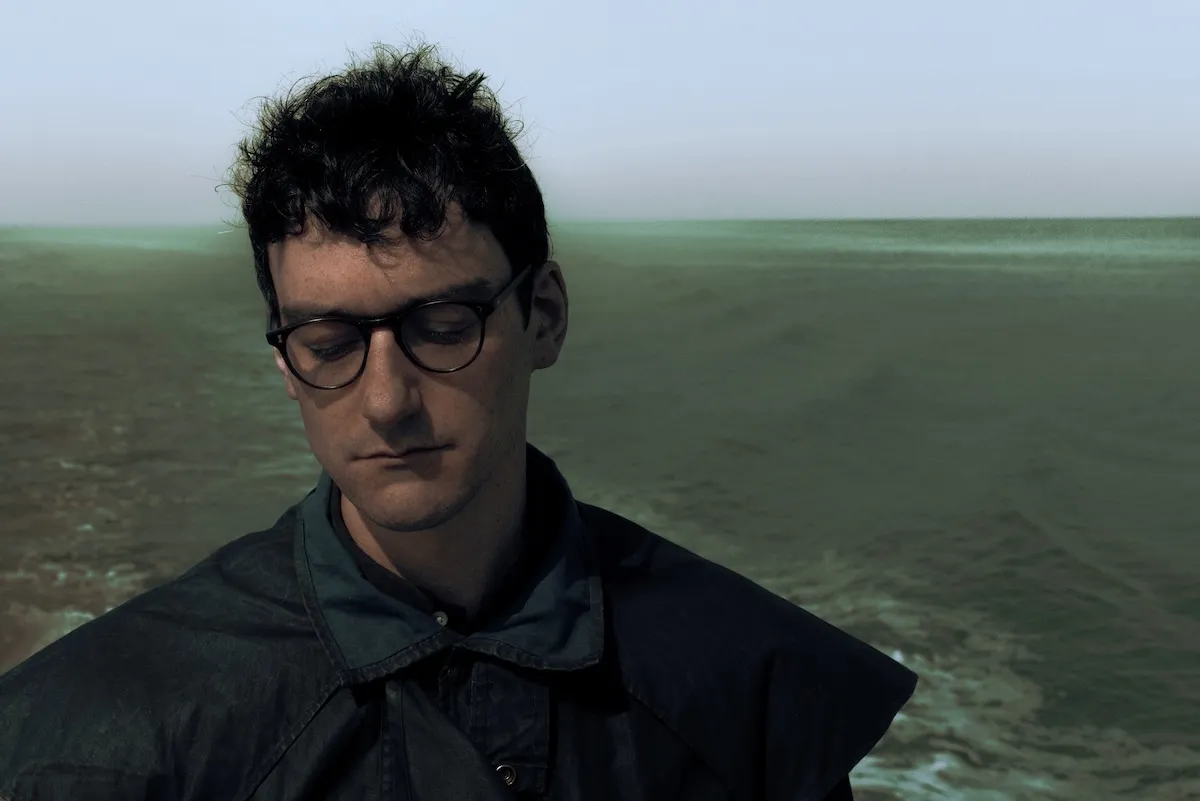
In Danny L Harle’s Hackney workspace, a handful of enchanted objects lie scattered about. A diminutive dark-silver knight wedges itself between speakers and monitors; a Merlin figure draped in stars lifts a vivid orange blaze skyward. Nearby, pieces that echo the pop mythos he’s helped shape appear: a black baseball cap from Caroline Polachek’s Pang, a red cornucopia spilling plastic grapes that echoes her “Billions” clip, a CD of Dua Lipa’s Radical Optimism, a wooden box stamped “Azimuth Circle,” and a black trench coat paired with a white buoy. The last two items nod toward Harle’s official debut, Cerulean, released now through XL.
I’ve come to meet Harle here to discuss a record he toiled on for four years. He’s wearing black, but his mood is warm and animated, pausing briefly from a London Fashion Week assignment. For more than a decade, Harle has been a mainstay of the scene, sharpening his pop maximalism as a founder of PC Music and then partnering with a wide circle of avant-pop trailblazers like Polachek, Charli XCX, Yeule, and Oklou. While his large-scale collaborations may have delayed a solo album, much of Cerulean’s core ideas wouldn’t exist without his work with artists such as Polachek, Lipa, and Julia Michaels.
Even though Harle has already issued a solo project, 2021’s Harlecore, that release was pitched more as a “multimedia experience.” Cerulean, by contrast, to him represents “a musical manifesto for the sound I’m chasing.” The record came together over four years, with the most intense labor concentrated in the past twelve months. Whereas Harlecore fixated on exuberant hardcore, Cerulean emerges as a laboratory-born blend of classical and dance rhythms. He calls it a “lower concept.” There’s a film that accompanies the project and ocean recordings that ground Cerulean in its own singular realm, yet the music remains the priority.
Cerulean stands as a formidable achievement. It’s endlessly engrossing—like a portal, yet razor-sharp in its emotional accuracy, conveying the ineffable scale of supreme feeling. He returns again and again to euphoric melancholy as a foundational element of his sound, and the album captures the restlessness between longing and calm, constantly glimmering, sparkling with glitter, and conveying a sense of ascent and reach.
When you hear a voice, do you already know how you want to deploy it in your music? Or do you need to explore an artist’s practice first to understand its fit?
HARLE: It’s not so much a conscious choice as a visceral reaction to the voice, which then conjures a clear idea of what I’d love to hear it do. That’s essentially all I can offer. There have been instances where I’ve proposed something and the artist didn’t respond positively.
Your vision?
HARLE: Precisely. The material that people have heard me do well is almost always the work that has already found its path. We record it, release it, and move on. There have been numerous sessions where I’ve offered what I can, but it isn’t what’s needed. The reality is simple for me: I can only bring forth my own approach. I’m not a chameleon; it becomes obvious early on whether it will click.
Do you ever linger on those moments?
HARLE: No. [Laughs] It’s too straightforward. I’ve shown what I can contribute, and they opt for a different route. Through experience I’ve learned that if I try to bend toward that other direction, I’ll likely meet someone else who can do it better. The aim is to craft the best possible music, and I pursue that by focusing on what I personally want to hear.
When you describe this album as a manifesto, what do you mean by that?
HARLE: It represents my unwavering stance.
Is it foolish to ask you to condense that into words?
HARLE: I suppose what I’m saying is that my past releases felt like glimpses or fragments of a broader world. Cerulean seeks to knit together the various musical directions I’ve explored across my career.
I’ll offer a concrete example from my work with Polachek on Pang. I was experimenting with chords inspired by Bruckner from my classical training, transcribing and modulating them, suspending sequences, and then, almost as an experiment, pairing them with an EDM supersaw. The result was a distinct atmosphere: I fused the chords I adore with a sound I also love, retaining the essence of both classical music and electronic music without undercutting either. The challenge when merging genres is often to preserve what makes each element special, but I aimed to keep the essence I cherished and blend it with something new.
That mindset marked a trajectory toward this album. It showcases the kind of experimentation I pursued here—transcribing and studying harmony to test textures and chords, exploring how far I could push classical ideas against my love for dance music. Sometimes shifting chord sequences over a dance groove simply doesn’t work, because dance music often depends on repeating progressions. That realization led me to embrace more cloud-like harmonies. The track “O Now Am I Truly Lost” demonstrates this approach, and in “Te Re Re” you’ll hear the same chord language, but with a repetitive element that makes it fit for dance music. You can hear the album recycling the same material in different forms.
When I composed the piece “Laa” — in my opinion the strongest lyric on the record — it crystallizes that relationship most clearly: it opens with shifting harmonies that drift, and then a pan flute arrives to domesticate those changes and begin a self-repeating pattern. This tune marries the two hardest-to-align genres I was working with. Once that track was complete, I knew the album could be considered finished.
That’s your daughter on “Laa,” right?
HARLE: Yes, Nico is singing there.
What sparked that track? Was it Nico’s recording that inspired the surrounding world, or did another element trigger it?
HARLE: It began with a suggestion from a friend, Matt Copson, and XL’s Patrick North, who urged me to include a production showcase on the album—something that foregrounds my own voice. I crafted the chords and a rock-inspired section, but I still needed a throughline. [Plays the original recording of Nico.] That was the moment. I adore the lyric in “La”—it’s beautiful to hear it sung by a child. The track feels like the birth of the album in a peculiar way; at one point it almost served as the opening track.
Is lyric-writing often a stream-of-consciousness process?
HARLE: Absolutely.
It’s delightful to hear your daughters appear in your music, and it’s striking to read about your deep classical background and conceptual framing, while some tracks seem to outgrow language—there’s a compelling tension there.
HARLE: I’m a big admirer of words, but I sometimes require distance to let emotions surface. I enjoy music you can feel without understanding the language, and I also adore lyric-free work, like Meredith Monk’s Atlas. The first track that pulled me into Caroline Polachek’s world was her Japanese version of “I Belong In Your Arms.” Lyric-less or language-unclear moments can pull me closer to the emotion.
So how did “Azimuth” come about, given your work with Polachek?
HARLE: “Azimuth” and “On & On” were both seeded during Polachek’s own album process. Like many of our collaborations, those tracks were truly a 50/50 effort. Some pieces on Cerulean I wrote largely myself and later handed to the vocalist to perform, or sent to them for performance. Caroline is always deeply involved and contributes ideas. For “On & On,” it was her suggestion to extend the second drop and create a playful false finish at the end. It’s one of the album’s highlights.
I suspect she sensed these songs would anchor my record even before I did. Yet I initially imagined an album without features, embracing the tradition of dance music where the producer’s name stands alone. I quickly recognized that such an approach is not only unfair but also somewhat dismissive, and perhaps not ideal. It became clear to me that featuring collaborators was the right move.
Were there tracks initially intended to be all-instrumental or featureless that later changed?
HARLE: Maybe at first I imagined sessions with vocalists as a base, but I have a preference for very specific melodies—there are certain singers who can truly push those lines. If someone else took on “Starlight,” it might resemble a Pinkpantheress homage, which I wanted to avoid. I’ve always aimed to craft songs that only a particular artist could perform in the way I foresee.
In a recording session, do you immediately sense what’s yours and what’s theirs, or do you discuss it at length?
HARLE: With “Azimuth,” it was clear from the start—Caroline saw the potential and helped sketch the melody before we pivoted to focus on her project. We spent only a small amount of time crafting that line, then returned to it later.
With Dua Lipa, you wrote that track during your very first session together. When I learned I’d be working with her, I produced the instrumental for “Two Hearts” and thought it was exactly the kind of material I wanted her voice on. We wrote the song with Dua and Andrew Wyatt. Dua loved it, though she already had a larger plan for her album at the time, which became Radical Optimism. In the end she revisited “Two Hearts” to finish it, likely because she saw potential in it. Her time is valuable, and she dedicated time to completing the track, which I deeply appreciate.
Were Clairo and Julia Michaels very different in their approaches?
HARLE: With Clairo, I initially wrote the song as a trance piece intended for a DJ, but when I shaped the chorus, slowing it down allowed the material to breathe, and I realized I’d like Vashti Bunyan to sing it. I attempted to enlist her, but there wasn’t a response. I raised the idea with Clairo at a show, and she offered to sing it, sending her take back to me—astonishingly beautiful. Clairo’s reverence to Vashti Bunyan made the track possible in a way that only she could have achieved.
Julia Michaels proves to be an extraordinary vocalist. This happened during one of Dua Lipa’s sessions, when she was humming a melody—almost as a side note—producing a striking, quivering, fragile yet intensely focused melodic line that carried a haunting beauty even without words. I wrote the lyrics very instinctively. Julia had the melody, delivered it perfectly on the first attempt, embodying the album’s essence of euphoric melancholy in a way that showed she grasped my artistic intent without words. It was piercing in its clarity. That level of unspoken understanding is a remarkable form of communication that music alone can enable.
I’d never heard her sing like that before.
HARLE: In that track, her tone is somewhat monochromatic and mournful, which isn’t her typical take. She usually finds a novel angle on sadness, but this one has no distinct angle.
Speaking of monochrome: Cerulean—where did that concept originate? Was the lyric in “Azimuth” the seed for the title?
HARLE: The Cerulean idea came later. By the time I sat down to assemble the album, one of my tasks was to draw a throughline linking influences spanning centuries to contemporary sounds. Euphoric melancholy, alien beauty, and escapism all echo in the music I adore. The color cerulean, tied to the mood of the record, offered a fitting abstraction for a project that foregrounds the music itself rather than a grand concept. I also kept layering voice memos— recordings of the sea processed through various treatments—so the color and the ocean’s presence reinforced the thematic link. The color-coding of the sea felt poetically apt for naming the project Cerulean.
I’d like to hear more about the filmic world and how it integrates with the music. The project has a sci-fi, dystopian flavor. Is that a world that exists in reality or is it outside of time?
HARLE: It isn’t so much a literal setting for the album as a representation of how one listens. I consider listening to music to be deeply personal—an inner experience, different for each listener—while others may experience it in a more social context. I treasure the notion of “alone together,” where individuals share a space yet respond in their own way. It’s an idea I value highly. My favorite listening experiences often happen with headphones in a dark room or in a nightclub where you can have a solitary reaction among others. I drew inspiration from the Prodigy’s “No Good” video, in which Liam Howlett leans against the wall while someone else dances wildly beside him; that image captures the sense of freedom to receive music in multiple ways at once.
That idea—that push-pull between isolation and community, being in your head and among others—feels right.
HARLE: There exists a unique form of community born from the sense of being alone together, where people react in their own way without everyone following the same impulse. I often think of the Dark Souls games as a prime example of this.
I’ve heard you’re working with your kids—that sounds like an intriguing angle for your art, given the tension between sadness and euphoria and a child’s perspective that’s so pure.
HARLE: Absolutely. When my children were very young I didn’t sense a profound impact, but as they grew and confronted the world, I began to understand how they reframe time. This has a deep influence on my own practice because childlike wonder and the sense that reality sits at a threshold with fantasy feed my creativity. Children inhabit a world where myth and imagination feel possible, which is a powerful source of escapism that aligns with my own search for transcendence. I recall Disneyland’s ability to suspend reality—there are moments when a child hugs Winnie the Pooh or believes in the moment so fully that the boundary between real and imagined nearly vanishes. Those moments can move me to tears.
Do you encounter those moments while you’re making music?
HARLE: Oh yes, definitely—that’s how I know I’m doing my job.
Can you recall a moment when that emotional response crystallized?
HARLE: I’ll never forget finding the right approach to the “Facing Away” track, slowing it to breathe, and then tearing up as it came together. That moment of emotional clarity is a sign I’ve achieved what I hoped.
Is that the moment you felt the work had truly converged?
HARLE: It helps, though the process can also be quite technical. Sometimes the journey is a craft operation rather than an emotional surge, and Cerulean came together quite rapidly once that balance fell into place.
Some might find the minimalism of that track surprising. Is it tough for you to keep things so stripped-down?
HARLE: That’s the dream—writing with such economy. I’ve long admired Sophie’s idea of monophonic music, where a single melodic voice carries the entire piece without a bassline, drums, or other melodies. If you hear that kind of purity, you’d know it’s Sophie’s voice. That pared-down approach is the apex of craft for me.
Explain monophony?
HARLE: It’s a single thread—one melody solo, with nothing else vying for space.
That’s an ultimate expression, to have a voice so distinct you can write in pure monophony.
She did something like that, indeed.
HARLE: She absolutely did. That’s why you can hear her kickdrum in “BIPP” distilling into a bass synth—Sophie is crystallizing her voice with the leanest, most essential sounds.
Where do you stand on “cheesy” music?
HARLE: I never fully grasp the idea of “cheesy.” When I first started visiting Los Angeles, I’d encounter collaborators steeped in mainstream pop who suggested things I’d deem cheesy—yet I’d want to be part of it. I never believed cheesy was inherently bad, but some people would tell me a concept was corny, which in the American sense was surprising. It demonstrated that taste is multi-faceted, not universal.
There was a moment I read about—some quote about you getting emotional over the hamster dance; I can’t locate the interview, but it struck a chord with how you respond to pop objects.
HARLE: Yes—the instrumental interlude of “Hamster Dance.” I believe one of art’s finest feats is concealing something beautiful within something—a little ridiculous.
It makes me think of how I adore that Crazy Frog track, and the broader question of taste—what’s good or bad. I don’t fully subscribe to that dichotomy, but…
HARLE: It’s a tricky topic, because perhaps the “bad taste” of something serves as a shield that lets you access emotion more freely. I was discussing with Hudson Mohawke the way UK hardcore—an influence on Harlecore—uses fast tempos to allow listeners, including men who might feel fragile about embracing emotion, to engage with expressive melodies and chords. I don’t need that dynamic, but it helps me imagine a version where distance exists between me and the music, as if the song sings to me rather than through me.
You don’t see yourself as a vessel?
HARLE: No. I’d describe myself as a craftsman of objects.
BONUS ROUND: If you had a tiny personal museum or altar dedicated to you, what ten items would you display?
- A copy of Piranesi by Susanna Clarke
- A physical model of the “rubbish with no value” from Dark Souls, with a placard
- A painting of St Michael’s Mount that sits in my studio
- One of my three-year-old daughter’s psychedelic drawings of our family
- A very intricate Paul Laffoley-inspired diagram mapping all my chat and WhatsApp threads and their interrelations—often there are “casual” conversations running alongside “serious” ones, a kind of symphonic compartmentalization
- A large pile of black, tangled cables
- A MIDI transcription (all blocks) of Monteverdi’s “Duo Seraphim” etched into a 3D glass sphere
- The vinyl of “Neckbreaker” by Scott Brown, a gift from DJ Buenri during a Barcelona b2b with Pastis and Buenri
- Cerulean Receiver 2 (a device that captures melodic transmissions—coming soon)
- MC Boing bobblehead
Cerulean is out now via XL.