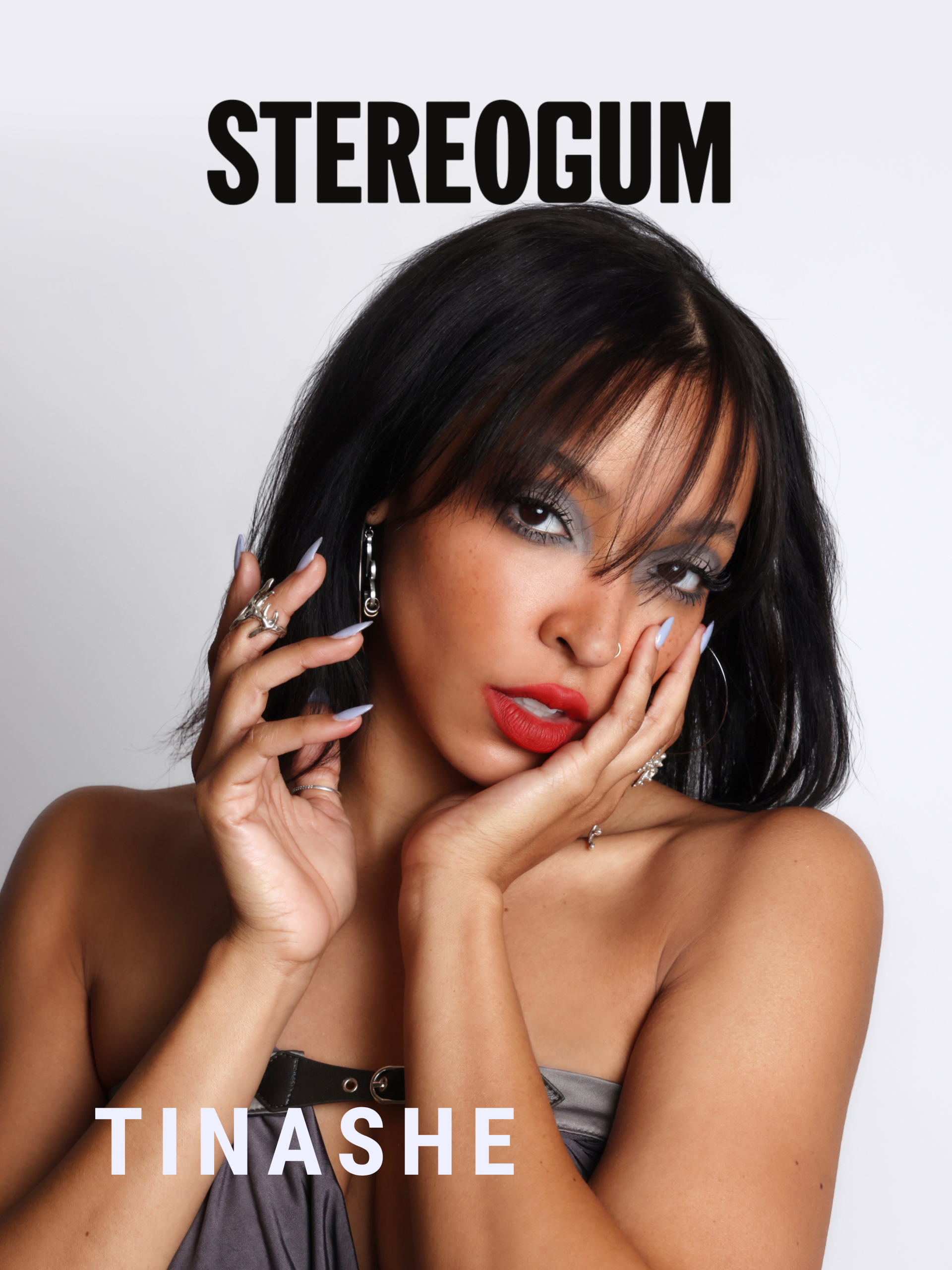
Tinashe notices nuance with precision. Minutes after stepping into the sunlit expanse of the Bishop Gallery in Brooklyn, she’s wearing a Denim Tears tee that features a photo of New York art-world figures Lee Radziwill and Andre Leon Talley. As she surveys the room, which houses a suite of Jean-Michel Basquiat’s early pieces, she stops before a handwritten page from a screenplay that never saw completion. “His E’s,” she remarks. “They’re scattered all over.” In my haste to follow the plot, I had overlooked the peculiar beauty of the E’s.
Perhaps it’s fate—an Aquarius, a former child actor, the eldest daughter—that gives the 33-year-old singer, songwriter, dancer, and actor a knack for probing what makes things distinctive. “I like to push myself to craft something that feels unexpected,” she says. “People arrive with ideas about what they think I want to hear or which direction I should take. Often, it’s far more compelling to challenge those notions and present the opposite.”
Popstar is an album that defies expectations. The eighth full-length by Tinashe, which drops this Friday, serves as the concluding piece of a trilogy she began with 2023’s BB/Ang3l and continued with 2024’s Quantum Baby. Yet when she started crafting the project two years ago, she felt it was something else entirely. “I followed my impulses and what felt right, and it didn’t feel complete until I wrote a bunch of songs.”
Stretching longer than her previous two releases combined, Popstar blends R&B and trap with touches of jazz and new age; the record also includes TikTok samples and lingering, spectral interludes. “Sunglasses,” produced by Arca, marries sparse electronics with a shuffled beat and Tinashe’s airy falsetto. Grounded by a four-on-the-floor foundation, “Melatonin” starts quickly and gains momentum as rubbery synths and acid-tinged breaks seep in.
There’s a discernible energy shift on the meditative “Empty Stadiums,” where a violin chorus mirrors Tinashe’s anxieties about whether she is “enough.” Yet these shifts feel seamless within the album’s arc, anchored by her chameleonic voice—direct and staccato on “Too Easy,” roaring to the back row on “I’d Rather Be Alone.”
Writer: Arielle Gordon
Photographer: Sydney Jackson
Editor-In-Chief: Scott Lapatine
Styling: Anna Trevelyan
Makeup: Brittany Whitfield
Hair: Karen Miller
Video: Spencer Kelly
Video Interviewer: Rachel Brown
SUPPORT STEREOGUM