- Labels: Touch And Go/4AD/Interscope
- Release year: 2006
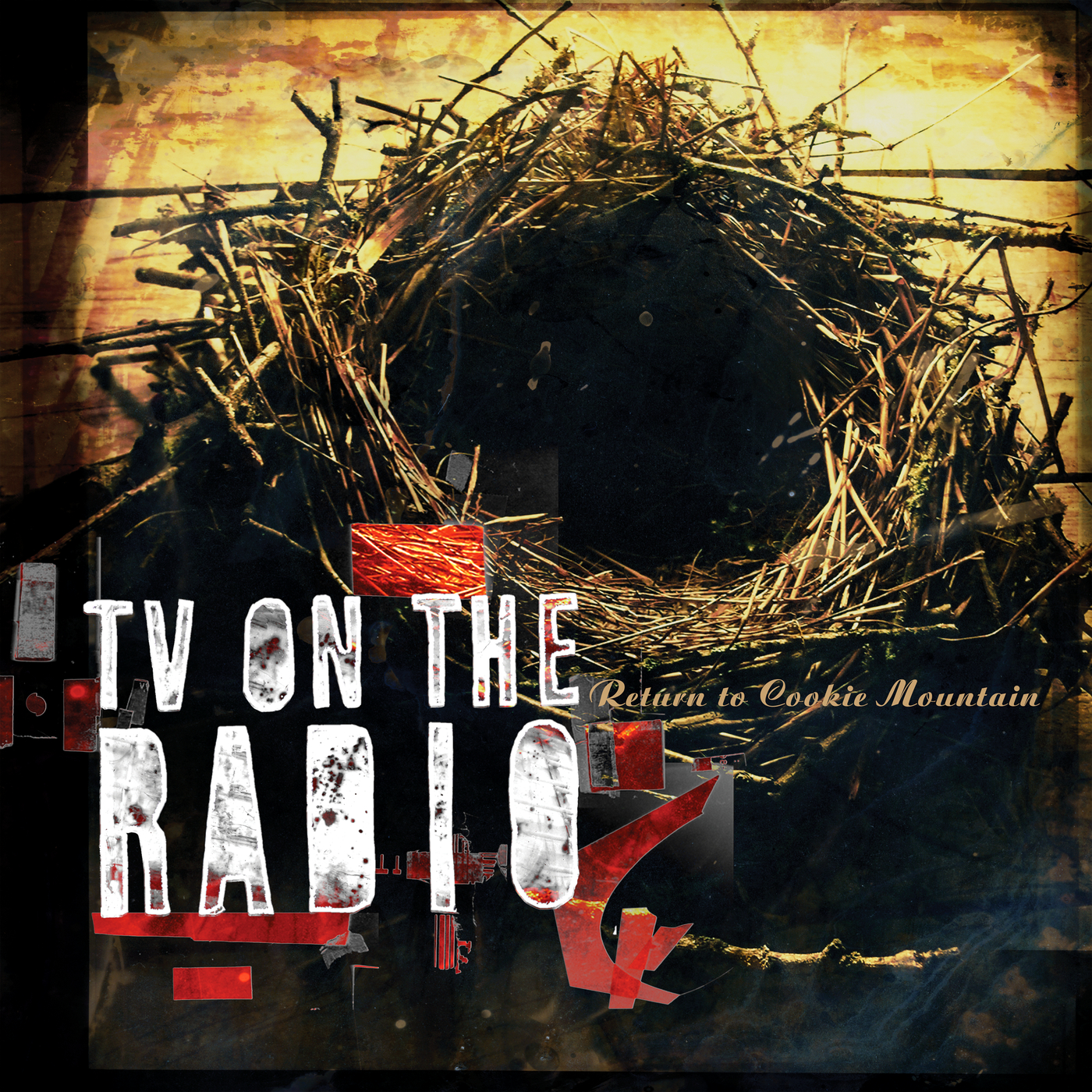
On the cover of the Village Voice, Bob Dylan ran over Kyp Malone in a Rascal scooter. This was February 2007, and Dylan’s 32nd studio album Modern Times had just barely edged out TV On The Radio’s sophomore release Return To Cookie Mountain to claim the top spot in the Voice’s annual Pazz & Jop critics’ poll. It was a photo-finish—1123 points for Dylan, 1109 for TVOTR. A solitary critic, who failed to file on time, could’ve altered the result. One shudders to imagine what the cover would have looked like if that had happened.
When that issue landed in red plastic newspaper boxes across New York City, I was on staff at the Voice, and the office exploded into absolute chaos. A predatory out‑of‑town conglomerate had just purchased the paper and proceeded to sweep away many of the institution’s veteran, formidable journalists. Among the first to go was Robert Christgau, the man who basically founded alt‑weekly rock criticism and who had overseen every Pazz & Jop poll since the thing began in 1971, then again in 1974. The Pazz & Jop issue featuring Kyp Malone’s accident‑prone roadkill was the first to appear without Christgau’s expansive, explanatory essay about what it all meant. His absence was acutely felt.
That moment at the Voice was a total shitshow. Nobody could say with any certainty that they’d still have a job the next day. I felt relatively safe, at least for the moment, because I was young, paid scraps, and mostly wrote for the website the new owners were determined to fortify, but I didn’t truly know I was insulated. The staff union threatened strike action. The new owners kept pruning away outstanding writers and editors. Numerous respected music critics vowed to boycott that year’s Poll, though Christgau did not join the boycott. Idolator launched its own critics’ poll, Jackin’ Pop, specifically to replace the supposed-dead Voice version, and the paper’s new proprietors did not take kindly to that move.
Chuck Eddy, the Voice’s music editor who had given me my break, also fell victim to the layoffs. In his place the new bosses installed a staffer they assumed would tow the corporate line: Rob Harvilla, the young music editor from their West Coast weekly, the East Bay Weekly. But Rob wasn’t interested in being a mouthpiece for the higher-ups—certainly not to those guys’ satisfaction. The first time I met Rob I was sure I’d take a liking to him only to despise him later, but within days we became close friends. Rob did whatever he could to preserve the magazine’s critical voice and to keep the institution from collapsing into itself. It wasn’t easy. In the lead‑up to that issue, there were fierce negotiations. A corporate big shot wrote a piece that attempted to belittle the entire rock‑crit scene, bragging that they were now the town’s new sheriffs or something equally ridiculous. Rob prevented that from happening, and the stress probably shaved years from his life.
In the midst of that hurricane, no one paused to consider whether the cover illustration—an over-the-top caricature of Dylan riding over an exaggerated Kyp Malone—was a bad idea. It sailed through everyone’s checks and balances. I don’t even recall seeing the final image before it went to press. People simply wanted to get the issue out. When readers wrestled with the cover, the response was, “Sure, of course—someone should have thought that through.”
One critic who rejected the cover’s premise was Martín Perna of Antibalas Afrobeat Orchestra, a musician who contributed to Return To Cookie Mountain. He sent a letter to the editor—yes, those still existed back then—stating, “Intentionally or not, this cover communicates the familiar message to people of color: If you craft something truly distinctive or step outside your assigned role, you’ll be crushed by a white guy.” This view wasn’t unique. Some argued the illustration carried racial and antisemitic overtones, and it also literalized a fictitious violence that arises when two artists are set against one another. Oops, indeed.
Anyway, it wasn’t surprising that Bob Dylan edged TV On The Radio that year. If Dylan had a new studio release in proximity to the poll, critics in the United States would crown it #1 almost by default. Time Out Of Mind trounced OK Computer. Love And Theft obliterated Is This It. The projects before and after Dylan’s late‑career trilogy—1993’s World Gone Wrong and 2009’s Together Through Life—had placed modestly, beneath Yo La Tengo’s records. Yet in that window when Dylan felt invincible, the field simply couldn’t compete. To win felt like achieving a kind of immortality.
Since Dylan and TV On The Radio exist on the same axis—only in relation to the Pazz & Jop critics’ poll—there’s probably a more fruitful way to tell the story when you put Modern Times side by side with Return To Cookie Mountain. The tale pivots around two generations of elusive, lyric‑driven rock poets, products of two different New York underground ecosystems, staring into the ash of Bush-era America and trying to conjure transcendence from the embers. Today, I hear Cookie Mountain as a chaotic masterpiece suited to a chaotic moment, a perfect soundtrack for that frantic scramble.
Return To Cookie Mountain hit shelves in the UK and Europe exactly twenty years ago today. In the United States, the release landed just one week before the fifth anniversary of 9/11, a timing that many critics couldn’t ignore. Before Cookie Mountain, TV On The Radio had achieved buzz‑band status at least partly because they emerged from the renowned Williamsburg, Brooklyn scene that predated 9/11 and received abundant attention in the years after. They were linked to other cutting‑edge New York outfits, notably the Yeah Yeah Yeahs. Their music carried sex and drugs imagery in a wild, kinetic rock ’n’ roll package, but it also carried a mournful gravity—a elegiac meditation on a once‑mighty empire that stubbornly persisted in decline to this day.
That funeral‑like mood saturates TV On The Radio’s debut full‑length, Desperate Youth, Blood Thirsty Babes (2004), though the band hadn’t yet mastered expressing the breadth of their ambition. In hindsight, Desperate Youth felt like a rough draft, a blueprint. TV On The Radio had already hinted at their potential with the 2003 EP Young Liars, and the years after that release were spent refining the craft to reach true greatness.
Step by step, TV On The Radio reached that apex. They shed the reliance on drum machines. What started as a trio expanded with two new members, bassist/keyboardist Gerard Smith and drummer Jaleel Bunton, fully integrated into the fold. (Both Smith and Bunton originally played guitar and hadn’t mastered those instruments when they joined; part of the Cookie Mountain magic lay in how they wrestled bass and drums into a guitaristic sensibility.) The band broadened its alliances, including a notable appearance by David Bowie on “Province.” They joined Interscope Records while maintaining ties to Touch And Go and 4AD. In an interview with SPIN, Sitek explained, “We aimed to reach listeners who aren’t flipping through Pitchfork.” Some might argue that they didn’t triumph with that audience, but the population of Pitchfork readers did indeed multiply.
Return To Cookie Mountain represents a band’s decisive leap into the major leagues while retaining its core identity. The elements that have always defined TV On The Radio—the towering howl of Tunde Adebimpe, its counterpoint with Kyp Malone’s falsetto, the intricate, storm‑driven production of Dave Sitek, and the gospel‑tinged gravitas infused into indie rock’s grit—were still present and sharpened. Yet the group learned to widen their scope, to discover epic resonance within their own tempest. They also learned to craft an anthem. Earlier tracks like “Young Liars” and “Staring At The Sun” already sounded expansive. But there are those cuts that truly astonish, and then there’s how “Wolf Like Me” could blow your socks off the first time you heard it.
“Wolf Like Me” feels like a collision of OK Computer and Is This It rolled into one thunderous cry. It’s a guttural, soulful shout of hunger and determination. Like all enduring anthems, it sounds both timeless and immediately of the moment of its birth. The riff explodes with interstellar propulsion, as if Spacemen 3 were navigating the 2001 monolith. The savage, nonverbal backing vocals from Malone and frequent collaborator Katrina Ford could howl forever. Adebimpe sounds like he’s surfing on lava—both tremulous and exultant, his heart blazing, his body strained, yet he revels in the force. If you’ve seen TV On The Radio’s performance of the track on Late Show With David Letterman, you know that moment of impossible magic was real. “TV On The Radio, that’s exactly what you’re looking for! Well done!” the host exclaimed, and you could feel something tremble in the room.
When Return To Cookie Mountain leaked online during the spring of 2006, “Wolf Like Me” was already established as the opening track. It’s tempting to say a band is fortunate to place its strongest song first, yet that would have been misplaced here. “Wolf Like Me” needed the buildup. It demanded space to unfurl. And though that anthem remains titanic and emblematic, my reread of the record suggests the eight‑minute closer, “Wash The Day Away,” might be the tiniest fraction superior. Feel free to disagree—this isn’t a verdict, merely a note that Cookie Mountain has the power to drive a reasonable listener to such a conclusion.
Even at its most kinetic, Return To Cookie Mountain operates as a symphony of anxiety. The voices—Adebimpe’s grand roar set against Malone’s falsetto—carry an atmosphere of perpetual unease. There’s the persistent tension of being one of the few Black acts in a largely white milieu. There’s the harsh reality of a rapid‑gentrifying megacity with a gaping crater where its famous landmark once stood. There’s the futility of dissent in the bloodthirsty era of Bush. The band had already taken a stand on their 2005 free downloadable protest track “Dry Drunk Emperor,” a rare move in indie rock at the time; Cookie Mountain arrives with the implicit understanding that you’re powerless to stop the carnage around you, a sentiment many peers weren’t ambitious enough to convey.
TV On The Radio possessed that ambition. Their sound carried a vision. Cookie Mountain is imbued with grandeur. On “Let The Devil In,” the group’s Antibalas and Dragons Of Zynth collaborators join in to scream a jubilant jazz‑funeral dirge about joining the bees. On “Dirty Whirl,” Adebimpe summons a near‑mythic memory of sex so potent it tilts the world on its axis. In a better world, an expansive international shoegaze‑funk movement might have blossomed from the tremulous clatter of “Playhouses.” Perhaps the album’s most hopeful moment arrives when David Bowie lends his commanding presence to the life guidance of “Province”: “Hold your heart courageously as we walk into this dark place! Stand tall, erect, and see that love is the province of the brave!” We can be heroes, just for one day.
About a week before the European release of Cookie Mountain, I joined thousands of fans at a free TV On The Radio show at Brooklyn’s Prospect Park Bandshell. The setting felt warm and familial: blankets on the lawn, bottles of wine quietly tucked away, children wandering about, clouds gathering ominously yet only dropping a few spits of rain. The evening’s openers, Voxtrot and Matt Pond PA, didn’t do much for me, but even some tepid indie rock sounded better in that open air. Then TV On The Radio burst forth with a surge of energy that seemed almost too expansive for a park. They were playing for 10,000 people who didn’t quite realize they were witnessing a band ready to explode in front of their eyes.
Two decades later, Return To Cookie Mountain still feels like a band pushing toward the edge. They weren’t chasing mass radio play or MTV airtime in pursuit of superstardom. “Wolf Like Me” earned its generational anthem status, but it took eighteen years to reach gold status, which isn’t quite the same as a standard pop hit. The band did receive rapturous reviews and larger venues, but they never pretended to pursue stardom. Their aim, as I understand it, was to craft an album capable of drawing electric currents from the air and wiring them into a lasting artifact—something that felt both of‑the‑moment and eternal. In that sense, they achieved their objective.
The most astonishing thing about Return To Cookie Mountain is perhaps that it isn’t even the best TV On The Radio record. The band’s ambitions just kept expanding. Those aspirations never propelled them into the pop‑star orbit, yet they contributed, in part, to the next TV On The Radio LP landing at the top of the Pazz & Jop poll—an achievement in a year when Dylan released nothing that year.