I only cracked a smile once while watching Green Day’s latest film Nimrods, a project marketed as a comedy that wobbles along the edge of that label. It behaves like a comedy, at least in its cadence and impulses. The characters drift into absurd, horribly foolish choices that pave the way for slapstick set pieces. They deliver lines in voices clearly meant to be amusing. A parade of so-called funny cameos by familiar comedians pops in, somehow feeling both too brief and too drawn-out all at once. I didn’t find any of that funny. Yet I did laugh, cruelly, when all seems lost and our adolescent underdogs think they’re bound back to Kansas City with their dream of opening for Green Day crushed, and the opening riff from “Wake Me Up When September Ends” suddenly crashes onto the soundtrack like the Kool-Aid Man. I doubt that was the intended moment for laughter, but it got one out of me.
I approached Nimrods with a willingness to enjoy it, even as the project looked like a cinematic catastrophe—Green Day, a potent and influential rock band with surprisingly slim film pedigree, joining forces with Live Nation, arguably the most uncool multinational conglomerate in the entertainment world, to chase a Hollywood fantasy. The DNA of the movie seems built on grossness, yet the premise—a road‑trip comedy about a teenage punk band—felt like it could touch on something I’m predisposed to like. When was the last time we got a true road-trip comedy? The Sure Thing, Pee‑Wee’s Big Adventure, Midnight Run, Almost Famous—all touchstones, then silence. Not much has followed.
What was the last genuinely good road trip comedy? Little Miss Sunshine, perhaps—two decades ago. We’re talking about a genre ripe for revival, and I wanted to be charmed. I was not. Nimrods is a draggy mess that misses its mark. It’s a noisy, leaden parade of dimwitted, loudmouthed characters who would have been hauled off to juvie dozens of times in any realistic setting, if consequences actually mattered. The flimsy plot and flat character sketches mostly function as a pretext to string together a handful of montages set to Green Day tunes. I’m fond of most of those songs (excluding the one about September), but the film’s packaging drags them down.
Mason Thames, the young lead, wears an open, approachable face and has previously headlined The Black Phone and the live‑action How To Train Your Dragon remake. He’s fine, I suppose, but he doesn’t particularly strike me as the ragged, desperate punk he’s meant to be. He inhabits the role of Tommy, a Kansas City kid in mourning for his father. Jenna Fischer, best known as Pam from The Office, plays his mother—a working, weary presence who lends a touch of gravity to a few brief scenes. Nobody else in the cast adds to that emotional bedrock. (Worth noting: Fischer is married to director Lee Kirk, who co-wrote Nimrods with Green Day; her appearance doesn’t hurt, but it’s not the reason the film exists.)
Tommy fronts Analog Dogs, a pop‑punk trio that sounds a lot like Green Day—so much so that Green Day themselves contributed a couple of the songs the band performs in the movie. Analog Dogs’ shtick is a fondness for vinyl and cassettes, which yields a collage of VHS‑style footage clipped into Nimrods without any attempt at seamless integration. The band’s bassist is Fred, a Pauly Shore‑inspired goofy pal named Fred, played by Kylr Coffman (indeed, not a typo). Then there’s Ryan Foust as Chad, the drummer who is a melodramatic mama’s boy, subject to the others’ attempts to “punk him up.” If it’s funny in theory to have a drummer who defies every stereotype, the actual exchanges between these characters simply don’t have any real punch or juice.
The setup: the boys’ antics irritate Tommy’s elder brother Wayne, played by Keen Ruffalo, the son of Mark. (I’m surprised there aren’t more nepotistic asterisks in this cast.) Since this film is stuffed with multiple Pauly Shore‑style comic relief characters, Wayne gets his own dimwitted sidekick to prank-call Tommy. Early on, Analog Dogs cut a chaotic swath in line to meet Green Day at an in‑store event and hand them a one‑song demo. Wayne’s sidekick pretends to be Tre Cool, inviting the band to Los Angeles to open for Green Day’s New Year’s Eve show at the Hollywood Palladium. Analog Dogs then abscond with Wayne’s car—one of several instances of car theft in the film—in order to reach the gig, which they have only verified via that prank call. And so the capers roll on.
Along the way, the guys encounter a parade of characters who are supposedly funny, portrayed by Fred Armisen and a cadre of performers who hover around that same level of comedic energy. They perform impromptu sets in a biker bar and at a fantastical junkyard skate‑park, collide and reconcile, and lurch from one scheme to another. None of the contrivances ever make the central premise feel remotely plausible, and they also reveal the characters to be jerks—yet we’re asked to root for them. I don’t have the patience to endure their whining.
There aren’t many recent films that focus on actual screwups, and Nimrods at least gives you a cast of real-life screwups who swear like sailors. They smoke, drink, and, in a single aggressively broad gag, hurl a giant bag of mushrooms into the mix. In a better movie, those traits might render them imperfectly human—flawed and relatable. In Nimrods, they amount to little more than a string of gags that never cohere into a convincing movie. We’re given a love interest in Mckenna Grace as a character who is sketched but never fully drawn, not even as a manic‑pixie dream girl. We’re given a mechanism to reach the finale in Chad’s mother, who materializes at just the right moment to scold the bandmates. And we’re promised a victory, so: there’s Green Day at the end.
Did you know Billie Joe Armstrong has already acted in a feature once before? About ten years back he played a middle‑aged punk rocker in something called Ordinary World, a project that Armstrong co‑wrote and directed through Lee Kirk. Its cast included Fred Armisen and several actors associated with The Office. I didn’t see that film, and you probably didn’t either. It didn’t catapult Armstrong into a new career as a film lead. Yet here he is again, front and center.
Watching Nimrods, I kept wondering who this movie is really for. Perhaps it’s meant for Green Day fans specifically. The film certainly lavishes them with admiration, presenting them as fired‑up, aspirational teenagers rather than middle‑aged folks who can now afford arena seats. But I’m not convinced that’s the angle either. It feels targeted at Green Day’s inner circle—the band members themselves and the people who work for them. It’s the product of various friendships and corporate affiliations, a résumé bullet with a flattering portrait of a band whose legacy should be handled with more care. It stands as one of the least convincing depictions of fandom I’ve seen in years.
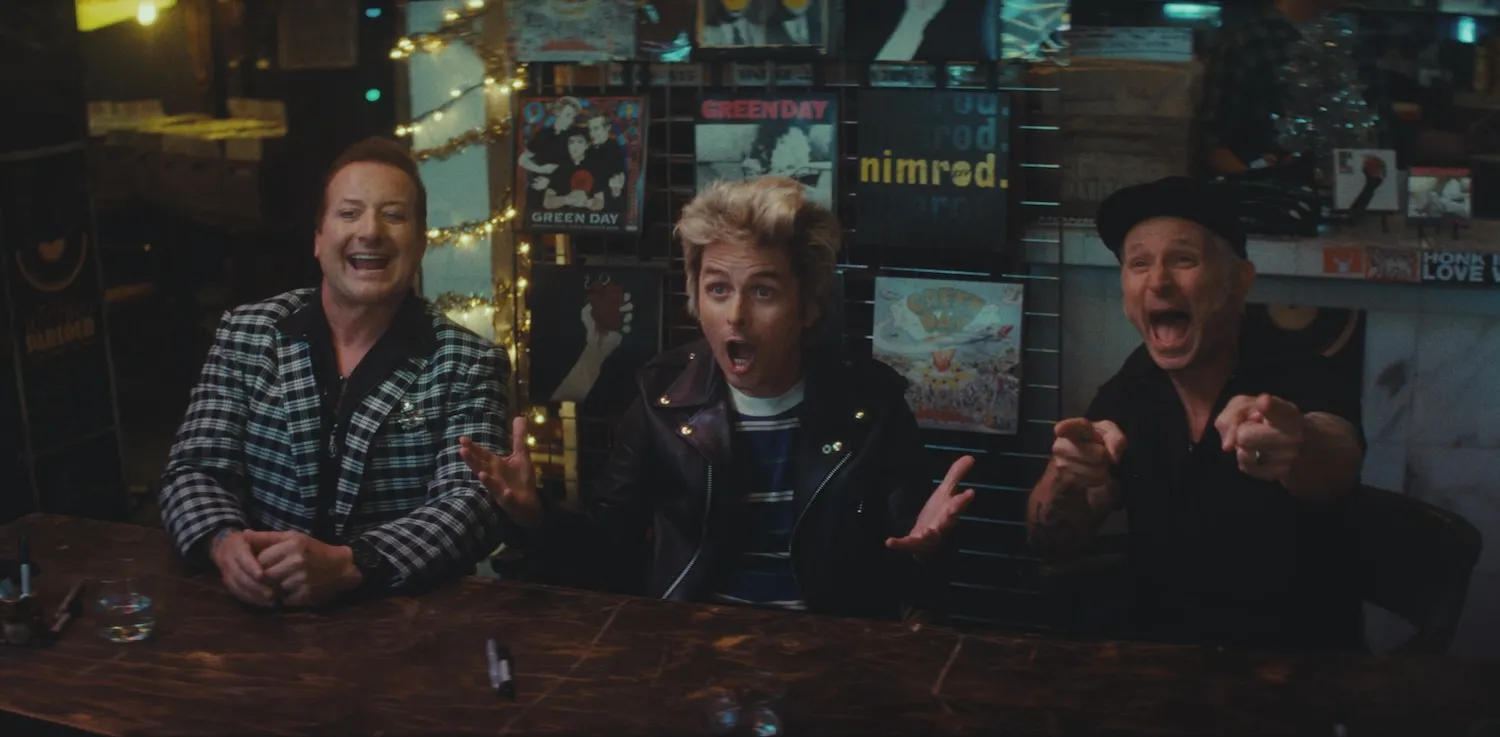
Early on, when Analog Dogs finally meet Green Day at a record store, Billie Joe Armstrong tells Tommy to keep playing wherever there’s a crowd. Green Day themselves did just that in their own early days, touring the country in a battered used ice-cream van—the very vehicle that surprisingly gets a fair amount of screen time in Nimrods. But Nimrods never communicates the idea of a band existing as a small part of a larger scene, a community.
Every character in Nimrods gushes about Green Day. They don’t merely like the band; they project it onto a broader fantasy of punk identity. Posters in their rooms nod to other foundational acts like Rancid, the Misfits, and My Chemical Romance. Dee Dee Ramone keeps surfacing in conversation, seemingly to offer a non‑Pauly Shore precedent for the film’s bulldozer‑comedy energy. Yet the movie never explores subgenres, basement‑show circuits, or regional scenes—elements that actually mattered in Green Day’s earliest days and still matter today. They’re absent from the glossy fairy tale Nimrods wants to tell.
Green Day is fond of celebrating DIY culture. But in Nimrods, the DIY ethos is overshadowed by a fantasy where the young punk band’s ultimate objective is to open for Green Day, to be near Green Day, to soak in Green Day’s reflected glory. It isn’t a story about making something with your own hands; it’s a story about doing it with the support of a mythical, aging, fabulously wealthy stadium act. The film never even commits to its own core joke—these kids are too stupid to realize they could never open for Green Day. After all, that would stand in the way of the endless Green Day montages that propel the movie forward, which is really the film’s raison d’être. You might find a laugh in that premise, but it won’t be the wholesome kind.
Nimrods hits theaters on 8/14.