
Picture this: I’m eighteen, side by side with my curly-haired, ink-splashed boyfriend as we step into a waterfront music shop in Williamsburg. I slip two CDs into my jacket, and after ghosting through the aisles and grabbing what we want—because we’re young, distrust capitalism, and crave the thrill of doing something a little forbidden—we drift back to his dented Toyota Camry and lay out our choices. He unveils his pick—likely some contemporary post-punk I don’t really care about—and I reveal mine. Sleepyhead and The Lamb. He asks for one; I let him borrow it, a small sign of my affection. He introduced me to her music, after all. Then we get drunk, shoplift a bit more, catch a show, and ride our feeling of invincibility until exhaustion finally catches up.
It’s no accident that Sleepyhead struck a chord with us. Lillie West’s self-released debut captures the raw, reckless joy of doing what you want despite the fallout and the hollow aftermath that follows. Recorded in a basement in five days, Sleepyhead feels like staring in a mirror the morning after a party, the hangover peering back, makeup smudged across the face. Her follow-up, 2018’s The Lamb, marked her Hardly Art debut and swapped out the scrappy sound and self-destructive pace for a more polished approach to expressing life’s chaos. In 2021, Lala Lala pushed into experimental territory with I Want To Door To Open, leaning into transcendence.
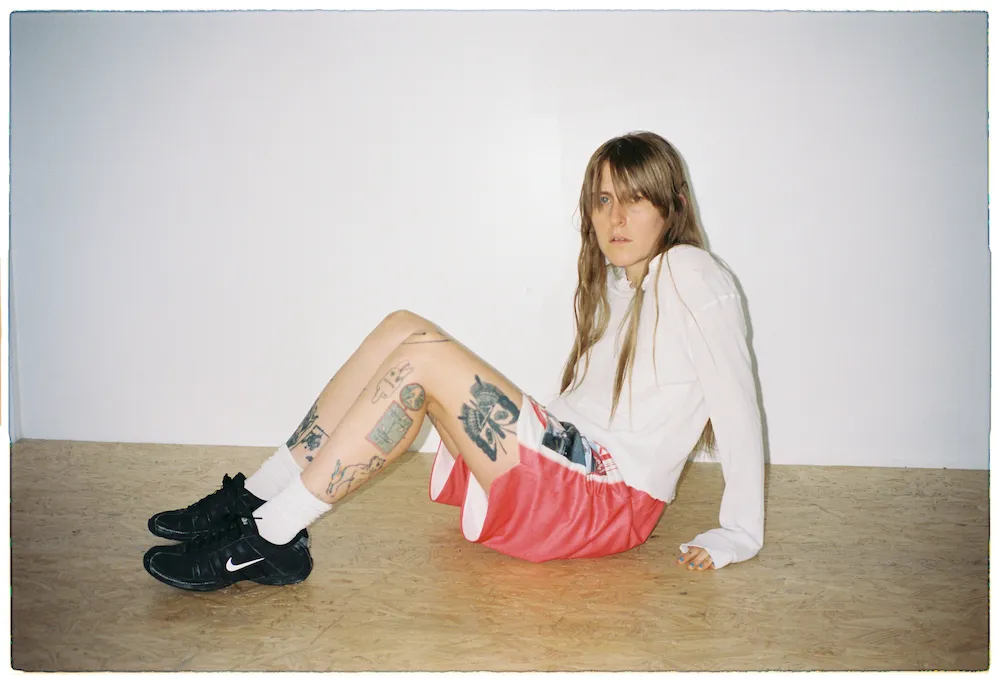
Today, the itinerant musician—once based in Chicago, now in LA, with detours through New Mexico, Iceland, and London in between—is prepping for her Sub Pop debut Heaven2, arriving this Friday.
Whatever path Lala Lala chooses, it always feels deeply human. The lead single from Heaven2, “Does This Go Faster?” beautifully renders the inner storm at the core of her music—a restlessness, a pull toward the infinite. “It’s about this constant urge for more,” she explains during a Zoom call in mid-January. And yet the track lifts, composed and expansive, resisting the compulsion to accelerate.
Heaven2 stands as another triumph for an artist whose music evolves with her. In our chat, we explored the influences behind the new record, including Oneohtrix Point Never, CrossFit, Iceland, and even the concept of God. Read our conversation below.
Björk & Iceland
When did Björk first resonate with you?
LILLIE WEST: Back in high school. She’s such a bizarre beacon. It feels like a gift passed down from older, alternative crowds. She’s a lot like Stephen Malkmus—simultaneously unmistakable and motherly.
I discovered her in my teens, and later, while writing this album, I spotted her at a cinema near Reykjavik. You’re not supposed to bother her; she values her privacy, and people leave her be there. But I found myself clocking Homogenic a lot, and there’s this track, “Bachelorette,” that I kept looping while in that theater, half-expecting to glimpse her in the corner.
You went to Iceland for a residency in a small town there. Did you end up living in Iceland after the residency?
WEST: I was living in New Mexico in a ramshackle off-grid community when I did the residency in Iceland, which ended up being among the happiest times of my life. I spent a month in Seyðisfjörður, a tiny town on the East Coast where daylight barely exists—only about two hours a day. We did wild outdoor survival stuff, met a bunch of people, and I eventually left the eco-housing scene because it proved more challenging than I’d anticipated. I stored my belongings, and for about two years I couldn’t stay in Iceland longer than three months because of Brexit. So I hovered between Iceland and England, sometimes dipping into California or New Mexico—but most of the time I was in Iceland. I’m famously flighty.
I’m curious about you learning to forge a knife during the residency.
WEST: Yes—Palli, the knifemaker. An elderly Icelandic man who taught us how to craft blades. Later, I was in LA chatting with Jónsi from Sigur Rós and I said, “I made this knife with that knifemaker,” and he replied, “Palli.” I couldn’t believe he knew the man.
You also did a backpacking trip through a blizzard?
WEST: That happened during LungA, another residency. Seyðisfjörður is nestled in a fjord, with water on one side and mountains on the other; the tip of the fjord houses Skálanes, a research center run as part of an art-and-science program. In summer you can drive there, but in winter you hike for eight hours to reach it. We did just that. On the way back, a bird was dying and one of the fellows snapped its neck and we later ate it. It was a wild, intense experience. We carried all our provisions, and the weather grew so harsh that we ended up stranded at the research center and had to ration food. It was utterly wild. Then we trudged back through the storm.
What was your feeling about eating the bird?
WEST: I didn’t eat it; I was vegetarian at the time. I watched everyone dismantling it and felt oddly relieved that the bird’s suffering would not be wasted. The bird was one of those small, pristine Icelandic species—white, nearly invisible in snow. Pretty remarkable creatures.
Did you fear you might die?
WEST: Not really. The program’s leaders were all outdoorsy Icelanders who knew the terrain and had emergency phones; Iceland’s emergency services are solid because weather can shift in an instant. Still, the experience was physically grueling, and I tended to push my body. I was training for a half marathon at the time, overdoing it, which left me injured for half a year.
Running & CrossFit
I get the sense sobriety pushed you toward endurance sports—running especially—and sometimes that leads to injuries.
WEST: That’s the classic arc. I’ll be sober for three years next month, and I found running about two and a half years into sobriety.
You mentioned CrossFit, too.
WEST: That’s where my fitness journey kicked off—the Icelandic CrossFit scene. A friend dragged me to these brutal classes conducted in Icelandic, which I don’t speak. I’d watch others, sometimes she’d translate, and I was by far the weakest. Icelanders approach fitness with this intense fervor. When she visited recently and it was pouring rain, she asked if I wanted to hike. I said no, I’m from Iceland—but really, that experience sparked a shift toward being more in tune with my body, which matters to me a great deal now.
Where do you go to run?
WEST: I used to run around my Pasadena neighborhood, near the Rose Bowl, but now I mostly swim. My body’s not the same since a hip labral tear, a misformed knee, and IT-band syndrome; the left leg is a wreck. So I’m doing laps at the YMCA and hot yoga.
Those are healthy things.
WEST: They’re fine. I’m not quite grateful yet—still a touch bratty about the situation. I miss running; it’s a temporary hold, I know, but I miss that rush.
I’ve only tried running on a treadmill, and it’s such a drag.
WEST: I can’t stand treadmills. I used to crush ten miles outside, then I hop on a treadmill and it feels intolerable. Kevin Morby calls it the “dreadmill.”
What’s your trick for conquering the fear of running outdoors?
WEST: You just do it. That’s my trick for overcoming fear in general—just start. And when it comes to running, go incredibly slowly. If you think you’re going slowly, you’re not. When my partner and I run together, he’ll put his hand out to gently slow me down. You have to move at a pace that actually works for you. And sure, there are folks who love climbing and can’t stand the idea that others don’t—same dynamic as running: you just have to try, and you’ll see you can do it if you go slower.
Oneohtrix Point Never, Brian Eno, & Aphex Twin
WEST: I’ve been dwelling on A Barely Lit Path, one of OPN’s newer pieces. He’s got a few records I adore—his soundtrack work is especially compelling. I recently joined his School Of Song workshop. And I love Brian Eno’s The Big Ship—that one is so instantly classic, you hear it and think, “I’ve heard this before,” yet it remains revelatory. It’s such a universal, awe-inspiring piece. A Barely Lit Path does something similar for me: it’s cinematic, melodramatic, and exquisitely moving. Both tracks feel like the climactic moment of a film, the big finale.
Were you curious about how Oneohtrix Point Never shapes your production, given that you’ve done some production yourself?
WEST: Kind of. The last couple of records I’ve had a co-producer; Melina Duterte has had a major hand in this project. She’s a fantastic producer and musician who can really translate my language when it isn’t strictly musical; she can sense what I mean when I say something should be “crunchier” or “slipperier.” Some engineers and producers don’t get that kind of shorthand. But Melina is an excellent translator. It depends. The track Does This Go Faster? keeps a lot of the demo’s spirit—the intro is essentially the same; we just refined and added elements.
With Oneohtrix, I’m always chasing that line where something feels mechanical and emotional at once. He, Björk, and Aphex Twin all strike that balance—harsh, yet heartbreakingly vulnerable. I’m drawn to music that’s scary and beautiful at the same time. I also admire how versatile those artists are; there are countless directions to take a song.
Do you have plans to collaborate with Oneohtrix?
WEST: I’m not sure. He’s huge now; he just scored Marty Supreme. I’m ready to say goodbye to that dream for the moment. Remember when he did Soccer Mommy’s record, though?
WEST: I do recall that. Soccer Mommy is bigger than me, though.
God
I’ve been thinking about how best to discuss God without scaring people. And then I just decided to say what I feel: I’m obsessed with the idea that I’m not in charge, that there’s a power beyond us, an energy moving through everything regardless of our recognition or surrender. Of course our actions affect people and the planet. It doesn’t mean we should quit trying to improve, but it does mean we should sometimes yield. We’re often embarrassingly self-centered, convinced of our own magnitude, which is ridiculous. I love the notion that I’m not the author of it all.
It’s intimidating, but I adore God. I don’t claim any specific religious identity or Christianity, but I feel deeply spiritual, and that has been a healing path for me. As a teenager I wore upside-down cross earrings and believed I knew everything; now I think, “I don’t know anything.” All I can do is the best I can and submit to the universe. And I love the universe. I love the world.
You’ve got an intriguing relationship with nature.
WEST: I’m absolutely smitten with it.
I wonder if that could be… God?
WEST: It might be—though it shifts. A friend of mine regards the ocean as their god; I’m not sure what mine is, but I suspect it’s something more powerful than myself. I’ve been thinking about this—and Nick Cave is famously consumed by God. I read an interview where people told him to stop talking about God, that it’s awkward. He replied that he’s always spoken about God; it’s part of who he is. He’s Christian, which isn’t my path, but I respect the sentiment. Why should discussing God be so taboo?
I did want to ask about death because a line in “Anywave” reads, “So scared of the end/ I can’t feel the now.” Does thinking about God lessen your fear of death?
WEST: Interesting question. I wasn’t contemplating death when I wrote that line. It speaks more to the end of anything I’m enjoying—whether a relationship, a career, or simply a moment of connection. I don’t dwell on death’s fear, but I do fear losing things. The concept of God offers comfort because it suggests there might be a reason behind loss. I don’t believe everything happens for a reason—the world is messy, people hurt one another—but I do like to trust that the end of something is part of a larger journey for me.
Heaven 2 is out 2/27 on Sub Pop. Pre-order it here.